Business confidentiality explained: protect your innovation

Every breach of confidentiality can cost your business an average of $4.45 million. Yet many business leaders struggle to understand what confidentiality truly means in legal and practical terms, leaving their competitive advantage vulnerable. This guide clarifies the essential distinctions between trade secrets and confidential information, explains the strengths and limits of legal protections like NDAs, and provides actionable strategies to safeguard your business data. Whether you’re scaling internationally or protecting innovation at home, understanding business confidentiality is critical for sustainable growth.
Table of Contents
- Defining Business Confidentiality: What It Covers And Why It Matters
- Confidential Information Vs. Trade Secrets: Legal Distinctions And Importance
- Legal Protections And Contracts: Ndas, Confidentiality Agreements, And Their Limits
- Practical Implementation Of Confidentiality Policies: Protecting Business Data Operationally
- Risks And Consequences Of Confidentiality Breaches: Financial And Reputational Impacts
- Common Misconceptions About Business Confidentiality And How To Avoid Them
- Bringing It All Together: Building A Robust Confidentiality Strategy For Innovation-Driven Businesses
- Protect Your Business Confidentiality With Expert Legal Support
Key takeaways
| Point | Details |
|---|---|
| Trade secrets vs confidential info | Trade secrets require economic value and proven secrecy efforts; confidential information is broader and often protected contractually. |
| Legal agreements have limits | NDAs are essential tools but cannot override whistleblowing laws or prevent all breaches; they work best within comprehensive strategies. |
| Operational policies matter | Written policies, employee training, and enforcement mechanisms are critical to make legal protections work in practice. |
| Breach costs are severe | Financial losses average $4.45 million per incident, with long-term reputational damage compounding competitive harm. |
| Avoid common myths | Not all business information qualifies as trade secrets; internal labels alone don’t guarantee legal protection. |
Defining business confidentiality: what it covers and why it matters
Business confidentiality is the foundation of competitive advantage and stakeholder trust. Understanding what qualifies as confidential helps you protect the information that drives your success.
Confidential business information legally covers trade secrets, proprietary data, business operations, and financial details whose unauthorised disclosure causes competitive harm. This definition reaches far beyond the narrow category of trade secrets to include customer lists, marketing strategies, pricing models, supplier agreements, and proprietary processes that give your business its edge. Business confidentiality also extends to personal employee data and client information that, if disclosed, could harm your company’s reputation or violate regulatory obligations.
Why does this matter strategically? Your confidential information represents years of investment, research, and relationship building. Protecting it preserves your market position, maintains client trust, and ensures you can capitalise on innovations before competitors do. Legal and regulatory frameworks across jurisdictions recognise and protect confidential data through contract law, trade secret statutes, and data protection regulations. However, protection only applies when you can demonstrate that information genuinely warrants confidential status and that you’ve taken reasonable steps to maintain secrecy.
Key categories of confidential business information include:
- Trade secrets: formulas, patterns, devices, or compilations that provide economic advantage
- Financial data: pricing strategies, cost structures, profit margins, and forecasts
- Customer information: client lists, purchase histories, preferences, and contact details
- Proprietary processes: manufacturing methods, operational workflows, and quality control systems
- Strategic plans: expansion strategies, acquisition targets, and partnership negotiations
- Employee data: personal information, compensation details, and performance records
Understanding this broad scope allows you to identify what needs protection and allocate resources accordingly. The next step is distinguishing between general confidential information and the narrower legal category of trade secrets.
Confidential information vs. trade secrets: legal distinctions and importance
The legal distinction between confidential information and trade secrets determines which protections apply and what you must prove in disputes. Getting this right protects your interests and strengthens enforcement.
Trade secrets require proof of economic value and reasonable secrecy efforts, whilst confidential information is broader and often contractually protected. Trade secret law provides powerful remedies, including injunctions and damages, but only if you meet strict legal tests. You must show the information derives independent economic value from secrecy, isn’t generally known or readily ascertainable, and that you’ve made reasonable efforts to maintain its secrecy. Confidential information includes anything sensitive that you designate as confidential through contracts, policies, or operational practices, even if it doesn’t meet trade secret criteria.

Misclassifying information creates serious risks. Claiming trade secret protection for data that doesn’t qualify weakens your credibility in legal proceedings and may result in courts refusing protection altogether. Conversely, treating genuine trade secrets as mere confidential information may mean you fail to document the secrecy measures needed for robust legal protection.
| Aspect | Trade Secrets | Confidential Information |
|---|---|---|
| Legal standard | Must prove economic value and secrecy efforts | Broader scope, often contractual |
| Protection scope | Specific statutory remedies and injunctions | Contract-based protections and policies |
| Proof requirements | High burden: unknown to public, reasonable secrecy | Lower burden: designation and reasonable measures |
| Duration | Indefinite if secrecy maintained | Typically limited by contract terms |
| Enforcement | Statutory trade secret laws | Contract law and confidentiality agreements |
Pro Tip: Conduct a detailed legal assessment with experienced counsel to identify which information qualifies as trade secrets and document all secrecy efforts, access restrictions, and confidentiality training to strengthen enforceability.
This distinction shapes how you draft agreements, implement policies, and respond to breaches. Clear classification enables you to tailor protections appropriately and avoid gaps that competitors or former employees might exploit.
Legal protections and contracts: NDAs, confidentiality agreements, and their limits
Nondisclosure agreements and confidentiality clauses are essential tools, but they cannot substitute for operational discipline or override statutory rights. Understanding their role and limits ensures realistic expectations and effective drafting.
Typical NDAs and confidentiality agreements contain several core elements. The scope defines what information is covered, often using broad language supplemented by specific examples. Duration clauses specify how long confidentiality obligations last, balancing protection needs against reasonableness. Obligations detail what recipients can and cannot do with confidential information, including restrictions on disclosure, use, and copying. Remedies outline consequences for breach, from injunctive relief to financial damages. Exclusions clarify what isn’t confidential, such as publicly available information or data independently developed.
However, legal contracts cannot override statutory exceptions. Whistleblowing protections, for example, allow employees to report illegal activity without breaching confidentiality agreements. Courts also refuse to enforce agreements that unreasonably restrict competition or violate public policy. This means NDAs form part of a broader strategy rather than standalone solutions. For guidance on aligning legal contracts with business operations, consider specialist advisory support.
Best practices for drafting enforceable confidentiality agreements include:
- Define confidential information precisely, using clear examples and categories
- Tailor obligations to the specific relationship and information sensitivity
- Set reasonable durations that balance protection with enforceability
- Include specific remedies and jurisdiction clauses to streamline enforcement
- Exclude information already public or independently developed to avoid overreach
- Align agreement terms with operational confidentiality policies and training
Effective confidentiality agreements reflect operational realities. If your business relies on open innovation or collaborative development, overly restrictive NDAs may hinder partnerships. Conversely, failing to secure robust agreements before sharing sensitive data with third parties exposes you to preventable risks.
Practical implementation of confidentiality policies: protecting business data operationally
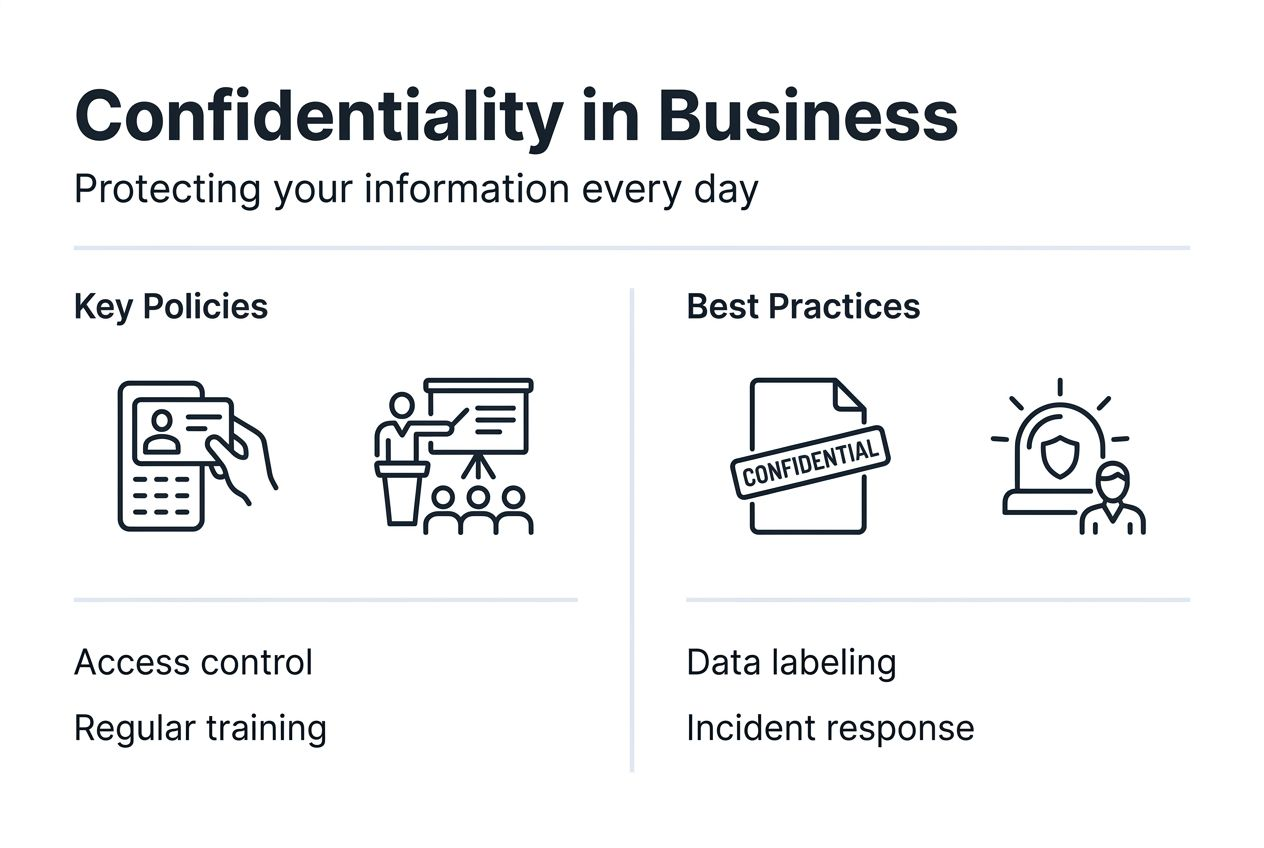
Legal agreements only work when supported by clear policies, consistent training, and disciplined operational practices. Building a confidentiality culture protects information day to day and demonstrates the reasonable efforts courts require.
Follow these steps to embed confidentiality protections operationally:
- Develop written confidentiality policies that define covered information, access controls, and employee responsibilities clearly and concisely.
- Include confidentiality clauses in all employment contracts, specifying obligations during and after employment with explicit consequences for breaches.
- Conduct regular training sessions that explain what information is confidential, why it matters, and how employees should handle it in daily work.
- Implement access controls and data security measures, such as password protections, encryption, and need-to-know access restrictions, appropriate to information sensitivity.
- Establish internal reporting mechanisms so employees can flag potential breaches or security concerns without fear of retaliation.
- Define clear consequences for confidentiality breaches, from warnings to termination, and apply them consistently to maintain credibility.
- Review and update policies regularly to reflect changes in operations, technology, and legal requirements.
Business confidentiality extends to employee and client data, requiring comprehensive operational measures beyond trade secret protections. Embedding confidentiality into everyday workflows reduces accidental breaches and signals to courts that you take secrecy seriously. This operational discipline becomes even more critical as you scale, face new legal risks when expanding, and integrate new employees or partners.
Pro Tip: Link confidentiality training closely to your innovation culture by fostering a team environment where protecting competitive advantage feels aligned with creative collaboration rather than restrictive.
Integrating confidentiality into operations transforms legal obligations into business advantages. Employees who understand why confidentiality matters become active guardians of your competitive edge, not passive rule followers.
Risks and consequences of confidentiality breaches: financial and reputational impacts
Confidentiality breaches carry severe, multi-dimensional consequences that extend far beyond immediate disclosure. Understanding these risks justifies investment in robust protections and urgent response protocols.
A breach of confidentiality can lead to financial losses averaging $4.45 million per incident, alongside significant reputational damage. These costs include incident response, legal fees, regulatory fines, customer compensation, and lost business. Competitive harm occurs when rivals gain access to your pricing strategies, customer lists, or proprietary processes, eroding your market position. Reputation damage undermines stakeholder trust, making clients, investors, and partners question your ability to protect sensitive information.
A breach of confidentiality in the workplace can lead to severe financial losses averaging $4.45 million per incident and significant reputational damage.
Breaches vary in origin and impact. Accidental breaches, such as an employee mistakenly emailing confidential data to external parties, often result from inadequate training or unclear policies. Whilst damage may be containable, repeated accidents signal systemic failures. Intentional breaches, where employees or partners deliberately disclose or misuse confidential information, carry malicious intent and often involve competitors or personal gain. These breaches justify immediate legal action and can result in criminal liability in some jurisdictions.
Key consequences of confidentiality breaches include:
- Financial losses: direct costs of $4.45 million on average, plus ongoing revenue impact
- Competitive harm: loss of market advantage as rivals exploit disclosed information
- Reputation damage: erosion of client and investor trust that persists long after the incident
- Legal liability: potential lawsuits from affected parties, regulatory penalties, and enforcement costs
- Operational disruption: incident response diverts resources from growth and innovation
Long-term reputational harm often exceeds immediate financial losses. Clients may terminate relationships, investors may withdraw support, and talented employees may seek employers with stronger confidentiality cultures. Rebuilding trust requires years of consistent performance, transparency, and demonstrable improvements in data protection practices.
Common misconceptions about business confidentiality and how to avoid them
Misunderstandings about confidentiality undermine protection efforts and create false security. Correcting these myths ensures your strategy rests on sound legal and operational foundations.
One widespread misconception is that simply labelling information as confidential guarantees legal protection. Internal designation alone doesn’t suffice. Courts require evidence of reasonable secrecy efforts, including access controls, training, and contractual protections. Marking documents “confidential” without operational follow-through may actually weaken your position by highlighting the gap between claims and reality.
Another myth is that NDAs ensure absolute confidentiality under all circumstances. Whilst NDAs are powerful tools, they cannot prevent accidental breaches, override whistleblowing protections, or eliminate enforcement challenges. NDAs work best as part of a comprehensive strategy combining contracts, policies, and operational discipline.
Some leaders mistakenly believe that all business information qualifies as trade secrets, entitling them to the strongest legal protections. Overclassifying information as trade secrets damages credibility and risks courts rejecting legitimate claims. Trade secret status requires meeting strict legal tests around economic value and secrecy efforts. Not all confidential information reaches this threshold.
Common myths and the corresponding realities include:
- Myth: Labelling documents “confidential” alone provides legal protection. Reality: Courts require demonstrated reasonable secrecy efforts beyond labels.
- Myth: NDAs guarantee complete confidentiality. Reality: NDAs are limited by statutory exceptions and cannot prevent all breaches.
- Myth: All proprietary business data qualifies as trade secrets. Reality: Trade secrets require specific legal criteria; broader confidential information needs contractual protection.
- Myth: Confidentiality obligations end when employment terminates. Reality: Post-employment obligations continue per contract and trade secret law, but must be reasonable.
- Myth: Confidentiality policies alone substitute for legal agreements. Reality: Policies complement but don’t replace enforceable contractual protections.
Avoiding these misconceptions requires honest assessment of what information truly warrants protection, realistic expectations about legal tools, and disciplined operational implementation. Legal counsel can help distinguish genuine protections from false security.
Bringing it all together: building a robust confidentiality strategy for innovation-driven businesses
Effective confidentiality protection combines legal rigour, operational discipline, and proactive risk management. For innovation-driven businesses, this integrated approach safeguards competitive advantage whilst enabling growth.
Your confidentiality strategy should align legal contracts with operational policies and ongoing training. Agreements set enforceable obligations, policies guide daily behaviour, and training ensures everyone understands their role. Regular reviews keep protections current as your business evolves, new technologies emerge, and legal landscapes shift. Proactive risk management identifies vulnerabilities before they become breaches, whether through audits, access reviews, or third-party assessments.
Clear enforcement mechanisms demonstrate your commitment to confidentiality. Consistent consequences for breaches, from warnings to termination or legal action, signal that confidentiality isn’t negotiable. This consistency also strengthens your position in disputes, showing courts that you take secrecy seriously.
Integrating confidentiality strategy with overall innovation and compliance frameworks ensures protections support rather than hinder growth. For example, understanding GDPR board-level responsibility helps align data protection with confidentiality obligations. Similarly, securing corporate and technology legal expertise ensures your confidentiality measures reflect best practices and regulatory requirements.
Strategic elements of a robust confidentiality programme include:
- Align legal agreements, operational policies, and employee training into a coherent, mutually reinforcing system
- Conduct regular reviews and updates to reflect business changes, technology developments, and legal requirements
- Implement proactive risk management through audits, vulnerability assessments, and access controls
- Establish clear enforcement mechanisms with consistent consequences for breaches to maintain credibility
- Integrate confidentiality protections with broader compliance, innovation, and growth strategies
- Engage specialist legal counsel for strategic advisory support tailored to your industry and jurisdiction
- Foster a confidentiality culture where employees understand the “why” behind protections, not just the rules
Effective confidentiality communications and operational practices ensure information protection becomes second nature. When confidentiality is embedded in culture, technology, and processes, you minimise risk whilst maximising the value of your proprietary knowledge.
Protect your business confidentiality with expert legal support
Safeguarding confidential information requires more than templates and good intentions. Expert legal guidance ensures your protections are enforceable, comprehensive, and aligned with your business realities.
Specialist legal services can help you draft customised NDAs and confidentiality agreements tailored to specific relationships, conduct policy reviews to identify gaps and strengthen operational protections, and implement risk mitigation strategies that balance security with innovation. Whether you’re expanding across borders, scaling rapidly, or protecting breakthrough innovations, experienced counsel ensures your confidentiality measures meet rigorous legal standards.
Pro Tip: Engage legal counsel early in partnerships, hiring, and strategic planning to align contracts and operations for maximum protection before sharing sensitive information.
Explore cross-border business legal advice and corporate and technology legal services to safeguard your competitive advantage with precision and discretion.
Frequently asked questions
What is the difference between business confidentiality and trade secrets?
Business confidentiality covers a broad range of sensitive information including customer data, financial details, and strategic plans that you protect through contracts and policies. Trade secrets are a specific legal category requiring proof of economic value and demonstrated secrecy efforts, offering stronger statutory protections but higher burdens of proof. Misclassifying information affects the protections available and your credibility in disputes.
Can a nondisclosure agreement guarantee complete confidentiality?
NDAs are essential legal tools that create enforceable obligations, but they cannot override laws such as whistleblowing protections or prevent accidental breaches caused by human error or inadequate operational controls. They form part of a broader confidentiality strategy that must include policies, training, and disciplined data handling. Relying solely on NDAs without operational discipline leaves significant gaps in protection.
How often should confidentiality policies and agreements be reviewed?
Confidentiality measures should be reviewed at least annually or whenever significant changes occur in operations, technology, legal requirements, or business strategy. Regular updates ensure your protections remain relevant, enforceable, and aligned with current risks. Stale policies and outdated agreements may fail to cover new information types, technologies, or regulatory obligations, creating vulnerabilities that competitors or disgruntled employees can exploit.
What are the common consequences of a confidentiality breach?
Consequences include financial losses averaging $4.45 million per incident, competitive harm as rivals exploit disclosed information, reputation damage that erodes stakeholder trust, and potential legal liability from affected parties or regulators. Both accidental and intentional breaches carry serious risks, though intentional breaches often justify immediate legal action and may involve criminal liability. Long-term reputational harm can persist for years, affecting client relationships, investor confidence, and talent retention.
Recommended
- Franjo Vučić – Corporate & Technology Lawyer | Vucic Legal
- Legal Risks When Scaling a Technology Company | Franjo Vucic
- Insights | Franjo Vucic Legal Advisory
- Startup legal checklist 2026: ensure compliance in Bosnia
- Understanding High-profile Whistleblower Cases in Silicon Valley Startups | Serendib Law Firm