International contract law: a guide for cross-border business

TL;DR:International contract law involves complex layers of rules governing cross-border agreements.Choosing the correct governing law and explicit clauses reduces dispute risks significantly.Modern frameworks like CISG, PICC, and PRICL shape how global contracts are drafted and enforced.
Cross-border deals can unravel over a single overlooked clause. Many business leaders assume that a well-drafted contract in their home jurisdiction will hold up internationally, yet the reality is far more complex. Jurisdictional conflicts, inconsistent enforcement, and gaps in governing law are among the most common reasons international agreements fail. Understanding international contract law is not a formality. It is a strategic necessity for any growth-oriented company operating beyond its domestic market. This guide covers the core frameworks, key challenges, and practical steps to protect your organisation in cross-border transactions.
Table of Contents
- What is international contract law?
- Core frameworks shaping global contracts
- Key challenges and edge cases in cross-border contracting
- Practical steps to safeguard your international contracts
- Why conventional wisdom on international contracts is not enough
- Unlock expert legal guidance for your international contracts
- Frequently asked questions
Key Takeaways
| Point | Details |
|---|---|
| Global contract rules | International contract law provides clear rules for cross-border business agreements, reducing risks and streamlining dealmaking. |
| Frameworks shape outcomes | Frameworks like CISG and UNIDROIT PICC harmonise contract laws, with each offering specific benefits and limitations. |
| Manage risk proactively | Understanding edge cases and evolving legal standards helps businesses avoid costly disputes and ensure compliance. |
| Expert guidance is key | Tailored legal advice ensures international contracts stay robust and aligned with business goals. |
What is international contract law?
International contract law governs agreements between parties located in different countries. It draws on a combination of domestic laws, bilateral treaties, and uniform international frameworks to establish rules for how contracts are formed, interpreted, and enforced across borders. Without a clear understanding of this body of law, companies risk entering agreements that are unenforceable, ambiguous, or subject to costly litigation in unfamiliar jurisdictions.
At its core, international contract law refers to the body of rules, conventions, and principles governing contracts between parties in different countries, primarily through uniform frameworks like the CISG and UNIDROIT PICC to harmonise cross-border transactions. This definition matters because it signals that no single national law governs all international deals. Instead, multiple layers of rules interact, and the outcome depends on which layer takes precedence.
For business leaders and legal counsel, three terms are essential to understand from the outset:
- Jurisdiction: The authority of a court or tribunal to hear and decide a dispute. In cross-border contracts, jurisdiction must be explicitly agreed upon or it becomes a source of conflict.
- Governing law: The national or international legal system that determines how the contract is interpreted and enforced. Parties can often choose their governing law, but this choice carries significant consequences.
- Enforcement: The ability to compel a party to honour its contractual obligations, often across national borders using treaties such as the New York Convention on arbitral awards.
For companies exploring commercial law explained in a business context, the intersection of these three concepts is where most cross-border disputes originate. Choosing the wrong governing law, or failing to specify one at all, can mean that a dispute is resolved under a legal system neither party anticipated.
“The choice of governing law is not a boilerplate decision. It shapes every aspect of how your contract will be read, disputed, and ultimately enforced.”
Companies seeking pragmatic legal solutions will find that early investment in understanding these fundamentals reduces exposure significantly. For a broader view of how these principles interact with corporate structures, corporate law for leaders provides useful context on how governance and contractual obligations align.
Core frameworks shaping global contracts
With the basics clear, let us explore the main legal frameworks that power international contracts and see how they compare.
Three frameworks dominate modern international contracting: the CISG, the UNIDROIT Principles of International Commercial Contracts (PICC), and the Principles of Reinsurance Contract Law (PRICL). Each serves a distinct purpose, and knowing when to rely on each is critical for sound contract strategy.
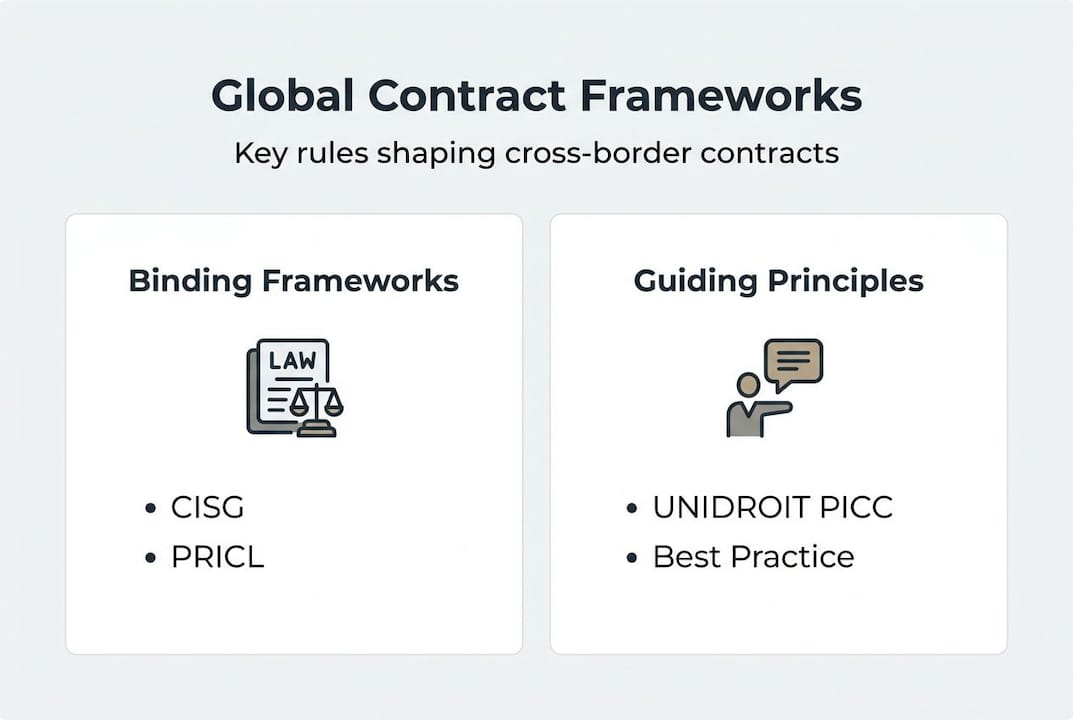
CISG (United Nations Convention on Contracts for the International Sale of Goods) applies automatically when both contracting parties are based in member states and the contract concerns the sale of goods. It covers contract formation, obligations of buyer and seller, and remedies for breach. Parties may exclude its application, but many do so without fully understanding what domestic law then fills the gap.
UNIDROIT PICC is a set of general principles for international commercial contracts. Unlike the CISG, it is not a binding treaty. Instead, it functions as a model law, a gap-filler, or a chosen governing instrument in arbitration. The PICC 2016 edition is used as model law, gap-filler, or governing law in arbitration and courts, influencing long-term contracts and national legal reforms across jurisdictions. Its 30-year track record demonstrates its value in stabilising complex, multi-party arrangements.
PRICL addresses insurance contract principles specifically, filling a gap that neither the CISG nor PICC adequately covers. For companies in financial services or those with significant reinsurance exposure, PRICL 2025 represents an important development.
| Framework | Binding? | Scope | Best used for |
|---|---|---|---|
| CISG | Yes (in member states) | Sale of goods | International goods trade |
| UNIDROIT PICC | No (model law) | General commercial contracts | Arbitration, gap-filling |
| PRICL | No (model law) | Reinsurance contracts | Insurance sector deals |
Pro Tip: If your contract involves services rather than goods, the CISG will not apply automatically. Consider explicitly incorporating UNIDROIT PICC as the governing framework to avoid relying on potentially unfamiliar domestic law.
For deeper analysis of how these frameworks interact in practice, international contract insights and contract structure strategy offer further guidance on structuring agreements to withstand scrutiny across jurisdictions.
Key challenges and edge cases in cross-border contracting
Knowing the frameworks is only half of the story. The real complexity emerges in edge cases and recent legal developments that can catch even experienced counsel off guard.
One of the most significant recent developments concerns asymmetric jurisdiction clauses. These clauses grant one party, typically a lender or stronger commercial party, the right to sue in multiple jurisdictions, while restricting the other party to a single forum. They have been contested in several EU member states on grounds of procedural fairness. However, asymmetric jurisdiction clauses were confirmed as valid under EU law by the CJEU in 2025, and the contra proferentem rule does not apply under CISG due to internationality overreach. This distinction matters enormously for financial and commercial agreements.

The contra proferentem rule, which requires that ambiguous contract terms be interpreted against the party who drafted them, is a standard tool in many domestic legal systems. Its inapplicability under CISG means that ambiguous clauses in international goods contracts may be interpreted differently than parties expect. Precision in drafting is therefore not optional; it is essential.
Consider the following scenarios where edge cases most commonly arise:
- Mixed contracts: Agreements combining goods and services may fall partly inside and partly outside the CISG, creating interpretive uncertainty.
- Digital goods and software: The CISG’s application to software licences and digital products remains unsettled in several jurisdictions.
- Multi-party arrangements: Joint ventures and consortium agreements involving parties from three or more countries can produce conflicting governing law claims.
- Force majeure clauses: Post-pandemic and geopolitical disruptions have tested the limits of force majeure provisions, particularly where CISG and domestic law diverge on what constitutes an excused non-performance.
| Challenge | Risk level | Recommended action |
|---|---|---|
| Asymmetric jurisdiction | Medium to high | Confirm validity in each relevant jurisdiction |
| Contra proferentem inapplicability | High | Draft with maximum precision; avoid ambiguity |
| Mixed goods and services | Medium | Specify applicable framework explicitly |
| Force majeure gaps | High | Draft bespoke clauses aligned to chosen law |
Pro Tip: Always conduct a jurisdiction-specific review before finalising any clause that relies on a domestic legal doctrine. What holds in one EU member state may not translate directly under CISG or in a third-country arbitration seat.
For companies operating within EU regulatory frameworks, EU compliance considerations and the legal guide Bosnia provide jurisdiction-specific context that complements general international contract principles.
Practical steps to safeguard your international contracts
Armed with an understanding of the frameworks and edge cases, here is what every business team should address before signing a cross-border agreement.
Effective international contract management requires a structured approach. The following steps reflect current best practice, informed by the evolution of global standards including the growing use of PICC in arbitration and its influence on ESG clauses and reinsurance standards through PRICL 2025.
- Conduct thorough due diligence: Verify the legal capacity of all contracting parties, confirm the regulatory environment in each relevant jurisdiction, and identify any mandatory rules that cannot be contracted out of.
- Specify governing law and jurisdiction explicitly: Do not leave these to implication. A clear governing law clause eliminates the most common source of cross-border disputes.
- Draft precise, unambiguous terms: Given the inapplicability of contra proferentem under CISG, every clause must stand on its own clarity. Vague language creates risk, not flexibility.
- Include a tailored dispute resolution clause: Choose between litigation and arbitration based on enforceability considerations. Arbitral awards are enforceable in over 170 countries under the New York Convention, making arbitration the preferred route for most international commercial disputes.
- Address modern risk factors: ESG obligations, data protection requirements, and sanctions compliance are now standard considerations in cross-border contracts. Omitting them creates both legal and reputational exposure.
Key elements to review in any international contract:
- Governing law and jurisdiction clause
- Force majeure and material adverse change provisions
- Representations and warranties with jurisdiction-specific carve-outs
- Dispute resolution mechanism and seat of arbitration
- Data protection and regulatory compliance obligations
- ESG commitments where applicable
Pro Tip: Consider incorporating UNIDROIT PICC as a supplementary source of interpretation in your governing law clause. This gives arbitrators and courts a neutral, internationally recognised reference point when domestic law produces unexpected results.
For ongoing guidance, expert legal insights and the corporate law guide offer resources to support your legal team through the full contract lifecycle.
Why conventional wisdom on international contracts is not enough
Many organisations approach international contracts as a compliance exercise. They use standard templates, run through a checklist, and assume that experienced domestic counsel can adapt quickly to cross-border requirements. This approach consistently underestimates the complexity involved.
The frameworks described in this guide are not static. UNIDROIT PICC has evolved over 30 years and continues to influence emerging areas such as ESG contracting and reinsurance. The CJEU’s 2025 ruling on asymmetric jurisdiction clauses illustrates how the legal landscape can shift in ways that affect contracts already in force, not just new ones. A contract that was well-drafted three years ago may now carry risks that were not present at signing.
The deeper issue is that contracts are strategic instruments, not administrative documents. How a contract is structured directly shapes investment outcomes and the distribution of risk between parties. Executives who treat contract review as a legal formality rather than a strategic input miss the opportunity to build real competitive advantage through superior contract design. Proactive, ongoing legal strategy is what separates companies that expand successfully from those that find themselves in costly, protracted disputes.
Unlock expert legal guidance for your international contracts
Navigating international contract law requires more than familiarity with frameworks. It demands precise, jurisdiction-aware counsel that keeps pace with evolving global standards.
At Vucic.legal, we support growth-oriented companies and their legal teams in structuring, reviewing, and enforcing cross-border agreements across European and global markets. Whether you need cross-border contract support for a specific transaction or access to strategic legal services across the full contract lifecycle, our team brings the depth and precision your deals require. For companies building their understanding of the legal landscape, business law essentials is a practical starting point.
Frequently asked questions
What is the purpose of international contract law?
International contract law provides a consistent set of rules to govern agreements between parties from different countries, reducing risks and misunderstandings that arise when domestic legal systems conflict.
When does the CISG apply to a business contract?
CISG applies when both parties are based in member countries and the contract covers the sale of goods, unless the parties have explicitly chosen to exclude it in their agreement.
What are the main risks in cross-border contracts?
Key risks include unclear governing law, jurisdictional disputes, and inconsistent enforcement. Asymmetric jurisdiction clauses and the inapplicability of contra proferentem under CISG are two specific areas requiring careful attention.
How can businesses reduce disputes in international contracts?
Careful contract drafting, explicit governing law selection, and expert legal advice significantly reduce dispute risk. The growing use of PICC in arbitration and its influence on ESG and reinsurance standards reflects a broader move toward standardised, enforceable global practices.
Recommended
- What is commercial law: a guide for business leaders
- Why legal guidance matters for business growth: key facts
- Insights | Franjo Vucic Legal Advisory
- Doing Business in Bosnia & Herzegovina | Legal Guide for International Companies
- Business Contract Notarization: Step-by-Step Guide Online - The Online Notary