Why companies need legal partners for growth in 2026

TL;DR:Companies need expert legal partners to navigate Bosnia and Herzegovina’s complex, multi-tiered regulatory environment.Legal guidance reduces delays, ensures compliance, and helps identify market opportunities within regulatory frameworks.Strategic legal partnerships improve operational efficiency, support growth, and provide ongoing compliance management.
Why companies need legal partners for growth in 2026
Bosnian and Herzegovina’s regulatory architecture is among the most layered in Europe, with requirements shifting not just between the two entities but across cantons and municipalities as well. For companies seeking to enter or expand in this market, the assumption that sound business strategy is sufficient to navigate this environment is a costly one. The fragmented regulatory landscape creates genuine operational risk for firms without expert local legal partners guiding their decisions. This article maps the terrain, explains the real consequences of proceeding without legal counsel, and outlines what effective legal partnerships look like in practice.
Table of Contents
- Understanding the legal landscape in Bosnia and Herzegovina
- Key reasons companies need legal partners
- How legal partners drive business efficiency and growth
- What to look for in a strategic legal partner
- A fresh perspective: What most guides miss about legal partnerships
- Find the right legal partner for your company’s growth
- Frequently asked questions
Key Takeaways
| Point | Details |
|---|---|
| Local legal expertise is critical | Navigating Bosnia and Herzegovina’s regulatory complexity requires in-depth, on-the-ground legal knowledge. |
| Delays and risks are preventable | Legal partners help avoid costly mistakes and accelerate crucial business processes. |
| Strategic legal advice fuels growth | Companies that integrate legal strategy achieve operational efficiency and competitive resilience. |
| Choose partners, not just providers | Selecting a legal partner with both expertise and local insight maximises business success. |
Understanding the legal landscape in Bosnia and Herzegovina
Few regulatory environments in Europe can match the structural complexity of Bosnia and Herzegovina. The country operates under a multi-tiered framework that distributes legislative authority across the state level, two entities (the Federation of Bosnia and Herzegovina and Republika Srpska), ten cantons within the Federation, and hundreds of municipalities. Each layer retains distinct competencies, and the rules at one level do not always align consistently with those at another.
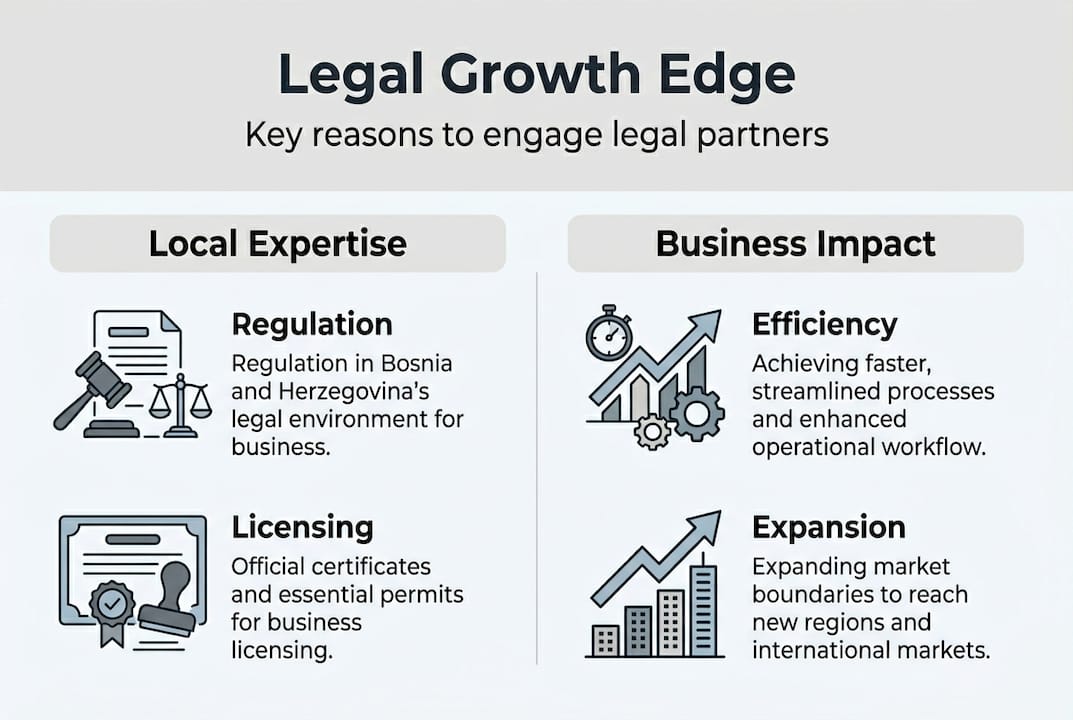
For a foreign investor or an expanding domestic company, this means that a single business activity can trigger compliance obligations at multiple levels simultaneously. Registering a company, obtaining a construction permit, or applying for a sector-specific licence may require separate processes with separate authorities, each demanding its own documentation and following its own timelines. The Investment Climate Statement published by the United States Department of State confirms that redundant and inconsistent procedures across these jurisdictional layers remain a central obstacle for both local and international businesses.
| Regulatory level | Key competencies | Common business touchpoints |
|---|---|---|
| State level | Foreign investment policy, customs, competition | Market entry approvals, import/export |
| Federation of BiH | Labour law, taxation, company registration | Employment contracts, VAT registration |
| Republika Srpska | Entity-specific company law, property | Land acquisition, local licensing |
| Cantonal level | Trade licences, education, health regulation | Sector-specific permits |
| Municipal level | Construction permits, local fees | Physical premises, local authorisations |
The table above illustrates why even routine operational decisions can become disproportionately time-consuming. A technology company establishing a sales office, for instance, may need to engage with municipal authorities for premises approval, cantonal authorities for specific trade licences, and the entity-level tax authority for registration, all in parallel.
“Bosnia and Herzegovina’s legal system is not simply complex; it is structurally fragmented in ways that actively generate procedural duplication and inconsistency. Without deep local knowledge, even well-resourced companies risk significant delays and compliance failures.”
For decision-makers unfamiliar with the territory, the legal guide for Bosnia provides essential orientation. Understanding the architecture is the first step, but navigating it effectively requires sustained expert engagement, not a one-time consultation.
Key reasons companies need legal partners
Knowing that a regulatory landscape is complex is different from knowing how to operate within it. This is where the value of a strategic legal partner becomes concrete and measurable. Legal partners do not merely assist with paperwork; they actively reduce exposure, accelerate timelines, and protect companies from decisions that appear sound on the surface but create liability further down the road.

Consider the area of licensing. In Bosnia and Herzegovina, sector-specific licences can be required at entity and cantonal levels, meaning that a single oversight at one tier can render an entire operation non-compliant. Regulatory complexity creates conditions where delays in licensing and registration directly translate into delayed revenue and increased operational costs. A legal partner who understands which authorities to approach, in which sequence, and with which documentation eliminates the trial-and-error approach that consumes management time and budget.
In cross-jurisdiction operations, the stakes are even higher. Companies operating across both entities must reconcile differing labour regulations, tax obligations, and reporting requirements. Without guidance, these discrepancies become sources of fines, rejected filings, and reputational damage. Proactive legal advice is not a reactive measure but a forward-looking investment that prevents compounding complications before they arise.
Key benefits that legal partners deliver include:
- Regulatory mapping: Identifying every applicable requirement across state, entity, cantonal, and municipal levels before operations begin.
- Compliance calendars: Structuring ongoing obligations such as reporting deadlines and licence renewals to avoid inadvertent breaches.
- Licensing coordination: Managing multi-authority processes concurrently to reduce total time to market.
- Risk assessment: Identifying clauses in commercial agreements or operational plans that could attract regulatory scrutiny.
- Dispute prevention: Structuring contracts and corporate arrangements to minimise the likelihood of disputes that drain management attention.
Pro Tip: Engage a legal partner before drafting any shareholder agreement, employment policy, or commercial lease. Retrofitting legal protections into existing arrangements costs significantly more than building them in from the outset.
The evidence supports early and sustained legal engagement. Legal guidance for growth consistently shows that companies which integrate legal counsel into their strategic planning process, rather than consulting reactively, achieve faster market entry, fewer compliance incidents, and more resilient operational structures. For growth-oriented companies in Bosnia and Herzegovina, this is not a discretionary advantage; it is a foundational requirement.
How legal partners drive business efficiency and growth
Beyond managing risk, legal partners directly improve operational efficiency in ways that are visible on a company’s timeline and cost base. The most immediate effect is on the business registration and setup process. A structured, legally guided approach to establishing a presence in Bosnia and Herzegovina reduces the number of iterations required with regulatory authorities and eliminates avoidable rejections caused by incomplete or incorrectly formatted submissions.
A typical legally guided setup process follows a clear sequence:
- Pre-registration assessment: The legal partner reviews the company’s intended structure, sector, and ownership composition to determine the correct registration pathway.
- Documentation preparation: All required filings are prepared to the specification of the relevant entity-level authority, with supporting documents authenticated and translated where required.
- Parallel authority engagement: Where cantonal or municipal approvals are needed alongside entity registration, the legal partner coordinates these simultaneously rather than sequentially.
- Tax and employment registration: Following company registration, the partner ensures timely registration with tax authorities and, where staff are employed, with relevant social contribution bodies.
- Ongoing compliance structuring: Post-setup, the partner establishes reporting obligations and monitors regulatory changes that could affect the company’s operations.
The contrast between this guided process and an unassisted attempt is significant. Local legal assistance reduces duplicative effort and supports smoother operations by ensuring that each step is completed correctly before the next one begins.
| Outcome | Without legal partner | With legal partner |
|---|---|---|
| Time to registration | Weeks to months of iteration | Structured timeline, fewer rejections |
| Licensing compliance | Risk of missed cantonal requirements | Full multi-tier compliance from outset |
| Fines and penalties | Elevated risk from procedural errors | Minimised through proactive structuring |
| Management time | Significant internal resource consumed | Freed for core business activity |
| Cross-border operations | Inconsistent entity compliance | Coordinated, entity-aware structuring |
For companies considering expansion across multiple regions, including cross-border operations into EU markets, the Bosnia business registration guide and access to cross-border legal expertise are particularly relevant.
Pro Tip: When entering Bosnia and Herzegovina from an EU jurisdiction, leverage your legal partner’s network across both regulatory environments. Many procedural requirements can be addressed in parallel, reducing total setup time by several weeks.
The efficiency gains are not limited to the setup phase. Ongoing operations benefit from a legal partner’s ability to monitor regulatory developments, update compliance frameworks as legislation changes, and advise on contractual structures that support rather than restrict commercial flexibility. This sustained engagement transforms legal support from a periodic cost into a continuous operational asset.
What to look for in a strategic legal partner
Not every legal firm operating in Bosnia and Herzegovina offers the same depth of expertise, local connectivity, or commercial orientation. For companies making a strategic investment in this market, the selection of a legal partner deserves the same rigour applied to any other critical business decision.
The 2025 Investment Climate Statement explicitly advises investors to obtain local assistance when navigating Bosnia and Herzegovina’s legal complexity. This recommendation reflects the degree to which local knowledge, built through sustained practice in the jurisdiction, determines whether a legal engagement adds genuine value or simply processes paperwork.
When evaluating prospective legal partners, consider the following criteria:
- Jurisdictional depth: The partner should demonstrate direct experience with regulatory processes at entity, cantonal, and municipal levels, not only state-level engagement.
- Sector-specific knowledge: Commercial law in Bosnia and Herzegovina intersects differently with technology, real estate, manufacturing, and finance. Relevant sector experience matters.
- EU regulatory literacy: For companies with European operations or expansion ambitions, the partner must be conversant with EU frameworks, including data protection, competition law, and cross-border transaction requirements.
- Network quality: Access to notaries, tax advisors, public registries, and institutional contacts significantly reduces the time needed to complete multi-authority processes.
- Communication clarity: Complex regulatory information must be translated into commercially actionable advice. A partner who communicates clearly across linguistic and technical boundaries is more valuable than one who produces voluminous documentation that leadership teams cannot act on.
- Responsiveness: In fast-moving commercial situations, including M&A transactions, regulatory investigations, or urgent contract negotiations, response time is itself a form of legal protection.
Understanding the role of legal advisors in a business context clarifies precisely what leaders should expect from a strategic engagement rather than a transactional one. Additionally, reviewing the legal requirements for partnerships provides a useful reference point for understanding the structural and contractual foundations that underpin effective legal relationships.
The best legal partners also bring a forward-looking perspective. They do not wait for a compliance problem to arise before engaging. They anticipate regulatory shifts, flag contractual vulnerabilities before disputes materialise, and position companies to move quickly when market opportunities open up.
A fresh perspective: What most guides miss about legal partnerships
Most discussions of legal partnerships frame them as a form of institutional insurance: essential, often expensive, and activated primarily when something goes wrong. This framing undersells what a genuinely strategic legal relationship delivers.
The most commercially effective legal partners are not reactive advisors. They are embedded in the company’s thinking about market positioning, product development, and competitive strategy. Regulations that appear to restrict activity often contain within them the conditions that favour early movers. A legal partner who reads the regulatory environment analytically, not just procedurally, can identify openings that competitors miss.
Companies that integrate legal counsel into their strategic planning process, treating it as a source of commercial intelligence rather than a compliance function, tend to navigate market changes with significantly more agility. They adapt faster, structure transactions more efficiently, and make fewer decisions that require costly unwinding later. Explore more legal insights on how forward-thinking legal strategy shapes sustainable business growth in Bosnia and Herzegovina and beyond.
Find the right legal partner for your company’s growth
The legal challenges described throughout this article are real, but they are also navigable with the right expertise in place. Companies that have built sustained legal partnerships in Bosnia and Herzegovina consistently report faster market entry, fewer operational disruptions, and stronger positions in commercial negotiations.
Vucic Legal offers precisely the combination of local regulatory depth and cross-border commercial experience that growth-oriented companies need. Whether you are establishing a new presence in Bosnia and Herzegovina, expanding across European markets, or managing a complex transaction, the strategic legal services available cover the full spectrum of business-critical legal needs. Begin with a review of the corporate law essentials that underpin effective company structuring, and take the next step towards a legal partnership that supports growth, not just compliance.
Frequently asked questions
What makes Bosnia and Herzegovina’s legal environment challenging for businesses?
The country operates under a fragmented multi-jurisdiction structure spanning state, entity, cantonal, and municipal levels, creating overlapping and often inconsistent requirements that generate procedural duplication and compliance risk.
Can international companies manage without a local legal partner in Bosnia and Herzegovina?
Local legal assistance is strongly recommended, as procedures vary significantly by entity and level. Duplicative and variable processes can delay or endanger operations without qualified local guidance.
How do legal partners streamline business registration and licensing?
Legal partners manage duplicative permits and coordinate multi-authority engagement concurrently, reducing total setup time and ensuring full compliance from the outset.
What should companies prioritise when choosing a legal partner?
Prioritise regional expertise, strong local networks across entity and cantonal levels, clear communication of complex regulatory requirements, and demonstrated responsiveness in time-sensitive commercial situations.