Cross-border law: a guide for European business growth

TL;DR:Cross-border law involves rules that determine jurisdiction, choice of law, and enforcement for international transactions. Understanding these pillars early helps companies avoid disputes, regulatory penalties, and operational delays, especially when dealing with Bosnia and Herzegovina. Effective legal strategies and counsel enhance cross-border growth and facilitate enforceable, well-structured contracts.
When a single contract connects parties in two different countries, the question of which laws apply, which courts hold authority, and how any resulting judgement can be enforced is rarely straightforward. Many businesses assume that their domestic legal framework will extend naturally across borders. It does not. Cross-border law governs precisely these situations, and companies that fail to account for it early in their international expansion face avoidable disputes, regulatory penalties, and costly operational delays. This guide explains what cross-border law is, how it operates in practice, and what companies expanding into or out of Bosnia and Herzegovina need to know in 2026.
Table of Contents
- Understanding cross-border law: key principles
- How cross-border law works in practice
- Key compliance challenges for Bosnia and Herzegovina businesses
- Dispute resolution in cross-border law: arbitration vs. litigation
- Our view: why early legal strategies win in cross-border expansion
- Expert legal support for cross-border business success
- Frequently asked questions
Key Takeaways
| Point | Details |
|---|---|
| Cross-border law basics | It governs international transactions, requiring careful attention to jurisdiction, choice of law, and enforcement. |
| Compliance is dynamic | EU regulations such as sanctions can change quickly and apply to Bosnia-based businesses growing in Europe. |
| Dispute resolution matters | Arbitration often offers advantages over litigation for cross-border enforceability and neutrality. |
| Early legal strategy pays | Engaging legal expertise early prevents costly misunderstandings and strengthens cross-border operations. |
Understanding cross-border law: key principles
Cross-border law is not a single unified code. It is a body of legal rules and methods that applies whenever a transaction, relationship, or dispute connects to more than one country or legal system. As one authoritative overview states, “cross-border law is the body of legal rules and methods used to handle situations where facts, parties, or transactions connect to more than one legal system or country.” That definition sounds technical, but its implications are deeply practical for any business operating internationally.
The field rests on three core pillars, each of which must be addressed whenever a transaction or dispute involves more than one jurisdiction:
- Jurisdiction: Which court or tribunal has the authority to hear a case?
- Choice of law: Which country’s substantive law governs the rights and obligations of the parties?
- Enforcement and recognition: Once a judgement or arbitral award exists, how is it recognised and enforced in a foreign country?
These pillars interact. A contract may specify English law as governing law while granting jurisdiction to Bosnian courts. Enforcing the resulting judgement in Germany then depends on whether Germany recognises that court’s authority. Each step must be planned deliberately.
“Cross-border law is not simply about knowing the laws of multiple countries. It is about understanding which laws apply, to whom, and how any resulting decision can be made to matter in the real world.”
For companies entering Bosnia and Herzegovina or expanding outward from it, the cross-border legal guide for Bosnia provides essential grounding. Bosnia operates under a complex constitutional and legal structure that distinguishes it from most EU member states, making a working understanding of cross-border legal principles even more critical for business leaders.
| Pillar | Core question | Practical example |
|---|---|---|
| Jurisdiction | Which forum can hear the dispute? | A supplier in Sarajevo sues a buyer in Vienna. Does the case go to Bosnian or Austrian courts? |
| Choice of law | Which country’s law governs the contract? | Parties agree German law applies to a services agreement, regardless of where performance occurs. |
| Enforcement | How is the decision made effective abroad? | A Bosnian court judgement must be recognised in France before assets there can be seized. |
Understanding these three pillars is the starting point. The next challenge is applying them to real business transactions.
How cross-border law works in practice
Knowing the pillars in theory is one thing. Applying them to a live transaction or dispute requires a structured approach. In practice, cross-border law “involves identifying jurisdiction (which forum can hear a dispute), choice of law (which substantive law applies), and enforcement/recognition across borders (how decisions/arbitral awards are recognised and enforced abroad).” That sequence is also the order in which legal counsel should address these issues during contract negotiation.
A structured approach to any cross-border agreement typically follows these steps:
- Identify all relevant jurisdictions at the outset. Where are the parties incorporated? Where will performance occur? Where are the assets held?
- Select governing law deliberately. Parties have significant contractual freedom here, but the choice must be commercially realistic and legally valid under the laws of both relevant countries.
- Agree on a dispute resolution forum. This may be a court in a specific country or an arbitral institution such as the ICC or VIAC.
- Assess enforcement prospects. Before signing, verify whether a judgement or award from the chosen forum can be enforced where the counterparty’s assets are located.
- Review regularly. Laws change. A jurisdiction clause that was sound in 2022 may carry new risks by 2026.
One area where businesses frequently make errors involves the distinction between governing law and jurisdiction. As noted in cross-border contracting analysis, cross-border contracting “often distinguishes ‘governing law’ (substantive rules) from ‘jurisdiction’ (which courts/tribunals hear disputes), and the enforcement of judgments abroad can depend on recognition/enforcement frameworks rather than the merits alone.” In other words, winning a case on its merits does not guarantee that the winning party can collect. Enforcement is a separate legal process with its own requirements.
Pro Tip: Always include a clause in international contracts that specifies both the governing law and the dispute resolution forum separately. Treat them as two distinct decisions, not one.
The comparison between arbitration and litigation is particularly relevant for companies operating across borders.
| Factor | Arbitration | Litigation |
|---|---|---|
| Neutrality | High: parties choose seat and arbitrators | Lower: court may favour local parties |
| Enforceability | Strong: New York Convention covers 170+ countries | Variable: depends on bilateral treaties |
| Confidentiality | Generally maintained | Usually public |
| Speed | Variable but often faster for complex disputes | Can be slow, especially cross-border |
| Cost | Significant upfront, but efficient long-term | Can escalate with jurisdictional complications |
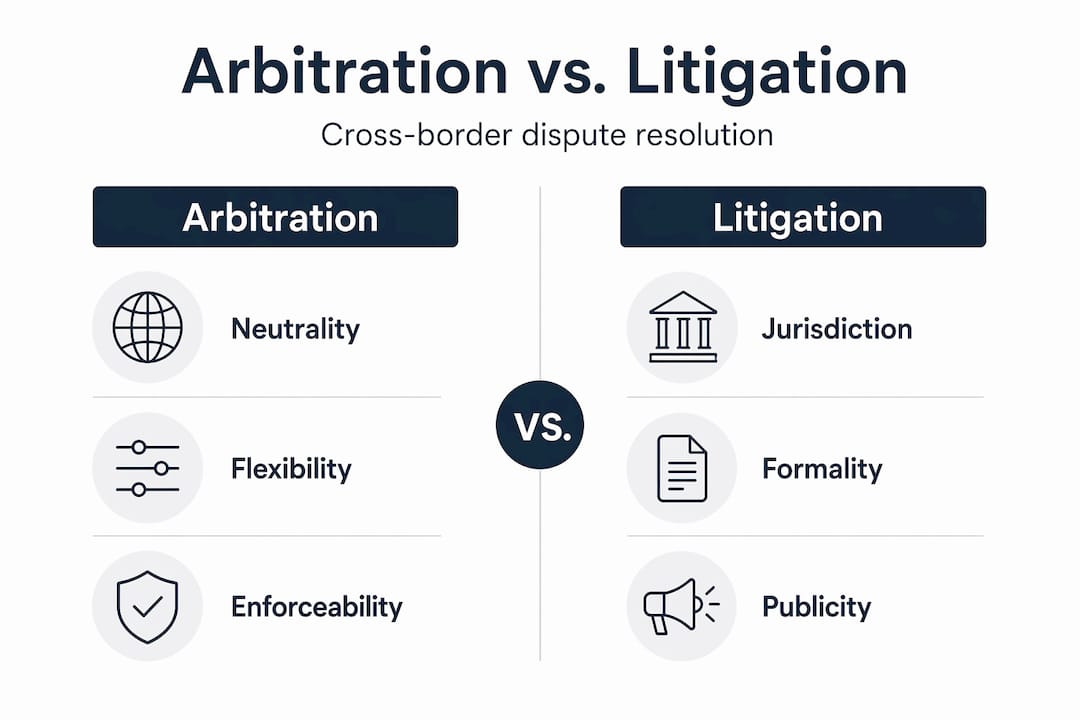
For most international commercial agreements involving doing business in Bosnia and Herzegovina, arbitration clauses provide considerably more predictable enforcement outcomes than submitting to the jurisdiction of courts in countries that may not have comprehensive mutual recognition agreements with Bosnia. The specifics, however, depend on the transaction type, the parties involved, and the governing legal frameworks. Working with counsel experienced in navigating Bosnian business law is essential when structuring these decisions.
Key compliance challenges for Bosnia and Herzegovina businesses
Companies with operations in or connected to Bosnia and Herzegovina face a specific and evolving set of cross-border compliance obligations. These go beyond ordinary contract law and touch on regulatory frameworks that carry significant penalties for non-compliance.
The most pressing compliance areas in 2026 include:
- EU sanctions screening: Businesses with any link to EU-regulated entities must verify counterparties against the EU’s restrictive measures lists. This obligation has sharpened considerably in 2026.
- Cross-border data transfers: Under the GDPR framework, transferring personal data from EU member states to Bosnia requires specific legal mechanisms such as standard contractual clauses or adequacy decisions.
- Anti-money laundering (AML): Bosnia has strengthened its AML legislation in recent years, and businesses engaged in financial services, real estate, or high-value transactions face robust due diligence requirements.
- Beneficial ownership transparency: EU-driven reforms have increased pressure on Bosnian registered entities to disclose ultimate beneficial owners to EU counterparts and regulators.
- Regulatory reporting: Companies operating across the EU and Bosnia must navigate dual reporting obligations, which can differ significantly in timing, format, and substance.
A particularly significant regulatory development affects businesses and financial institutions with any operational exposure to Bosnia. An EU sanctions update effective 30 March 2026 requires relevant companies and banks with operations in BiH to verify counterparties against updated restrictive measures lists. This is not a discretionary best practice. It is a mandatory compliance obligation for any entity subject to EU law that engages with Bosnian counterparties.
The consequences of non-compliance with EU sanctions are severe. They include asset freezes, financial penalties, reputational damage, and in some cases criminal liability for individuals in senior positions. The 30 March 2026 deadline marks an escalation in the scope and specificity of these requirements, and companies that have not reviewed their counterparty screening processes in light of this update carry real legal exposure.
Pro Tip: Establish a counterparty screening protocol that is triggered automatically at contract initiation and renewed quarterly. Sanctions lists are updated frequently, and a counterparty that was clean at signing may not remain so throughout the contract term.
For companies managing these obligations across multiple jurisdictions, cross-border business strategies require coordinated legal and compliance functions, not siloed advice. Understanding the corporate law essentials applicable to Bosnian entities is foundational before layering on the cross-border compliance dimension.
Dispute resolution in cross-border law: arbitration vs. litigation
Even well-drafted contracts and rigorous compliance programmes do not eliminate the possibility of commercial disputes. When disputes arise in a cross-border context, the resolution mechanism chosen at the outset of the relationship determines whether resolution is efficient or exhausting.

Expert analysis on cross-border dispute strategy confirms that “arbitration can be preferred for neutrality, flexibility, and international enforceability (e.g., under the 1958 New York Convention), while litigation may face challenges including jurisdiction, language, and procedure.” This distinction is not merely academic. It shapes the entire trajectory of a commercial relationship once a dispute emerges.
Key factors that should drive the choice between arbitration and litigation include:
- Location of counterparty assets. If a party’s assets are concentrated in countries that are signatories to the New York Convention, arbitration offers a considerably cleaner enforcement path.
- Sensitivity of commercial information. Arbitration is private. Court proceedings in most jurisdictions are public, which can expose commercially sensitive information during litigation.
- Complexity of the underlying dispute. For highly technical disputes, arbitration allows parties to select arbitrators with domain expertise. Judges in commercial courts may not have comparable specialist knowledge.
- Relationship preservation. Arbitration tends to be less adversarial in procedure, which can matter if the parties have an ongoing commercial relationship they wish to preserve.
- Speed. Neither mechanism is universally faster, but arbitration can be structured to proceed on an expedited basis in ways that national court systems generally cannot accommodate.
“The choice of dispute resolution mechanism is among the most consequential decisions made at the contracting stage. It determines not just how a dispute will be resolved, but whether that resolution will be practically enforceable.”
For international contract law involving Bosnian parties, it is worth noting that Bosnia is a party to the New York Convention, meaning arbitral awards rendered abroad can in principle be enforced in Bosnia, and Bosnian awards can be enforced in other contracting states. However, the practical application of this framework requires careful drafting of arbitration clauses and attention to procedural requirements in each enforcement jurisdiction.
Litigation remains appropriate in certain scenarios, particularly where the dispute involves public law elements, regulatory enforcement, or where the relevant assets and parties are concentrated in a single jurisdiction with a well-functioning court system. The key is that this choice must be made deliberately, with full awareness of its cross-border implications.
Our view: why early legal strategies win in cross-border expansion
The conventional assumption in many expanding businesses is that legal review is a final step in deal-making, a box to be ticked before signature. That assumption is costly. The reality is that the most consequential legal decisions in cross-border expansion are made in the early stages of structuring a transaction, drafting a contract, or selecting a market. By the time legal issues become visible problems, the options for addressing them are typically fewer and more expensive.
Companies that integrate legal counsel at the strategy stage rather than the documentation stage gain a measurable advantage. They negotiate from positions of greater clarity, avoiding commitments that create jurisdictional ambiguity or enforcement gaps. They structure their corporate presence in a way that minimises regulatory friction. They identify sanctions and data transfer obligations before those obligations become compliance incidents.
There is also a subtler benefit. Early legal engagement signals sophistication to counterparties. A company that presents well-structured cross-border contracts, with clear governing law clauses, coherent dispute resolution provisions, and evidence of sanctions screening, is a more credible commercial partner. It reduces the friction in negotiation and builds trust at the outset of relationships that may last years.
Understanding the importance of legal guidance is not simply about avoiding problems. It is about constructing the conditions under which a business can grow without avoidable legal constraints limiting its options.
The companies that struggle most with cross-border expansion are not those that lack resources. They are the ones that treat legal considerations as an afterthought. Reversing that approach, and treating cross-border legal strategy as integral to business planning, is the single most effective change an expanding company can make.
Expert legal support for cross-border business success
Cross-border legal complexity requires more than general legal knowledge. It requires counsel that understands the specific regulatory environment of Bosnia and Herzegovina, the applicable EU frameworks, and the practical mechanics of international contract and dispute management.
Vucic.legal provides precisely this expertise to companies expanding into and out of Bosnia and Herzegovina. Whether the priority is structuring cross-border business legal services, drafting robust international contracts, or completing a compliance review for 2026, the firm’s advisers work with clients to build legal foundations that support growth rather than constrain it. For companies ready to operate across borders with confidence and precision, tailored legal guidance is the practical next step.
Frequently asked questions
What are the three core pillars of cross-border law?
The three pillars are jurisdiction, choice of law, and enforcement or recognition of judgements or awards across different countries. Each must be addressed separately in any cross-border transaction or dispute.
How do EU sanctions affect businesses in Bosnia and Herzegovina in 2026?
From 30 March 2026, companies and banks with operations in BiH must verify counterparties against updated EU restrictive measures lists. Non-compliance carries serious financial and reputational consequences.
Why is arbitration often preferred over litigation in cross-border disputes?
Arbitration offers neutrality, flexibility, and enforceability through the New York Convention, which enables arbitral awards to be recognised and enforced in over 170 countries. Litigation can face significant obstacles in cross-border settings.
What happens if a business chooses the wrong legal jurisdiction for a contract?
Misjudging jurisdiction can create serious practical problems because governing law and jurisdiction are separate legal decisions, and an award or judgement obtained in the wrong forum may not be enforceable where the counterparty’s assets are located.