Dispute resolution process for entrepreneurs: a guide

TL;DR:Disputes are common and often inevitable in startups, especially in Bosnia and Herzegovina, where early resolution is crucial. Implementing structured processes, including mediation clauses and clear escalation steps, helps protect relationships and investments, reducing costs and avoiding legal crises. Cultivating a proactive dispute resolution culture supports sustainable growth and preserves business value during inevitable conflicts.
Disputes are not a rare occurrence in startups. They are, in many cases, inevitable. For entrepreneurs in Bosnia and Herzegovina building companies from the ground up, the dispute resolution process for entrepreneurs is not a legal formality to consider later — it is a core business function that determines whether a company survives its growing pains or fractures under them. Co-founder conflicts, investor disagreements, and partner misalignments are among the most common causes of early-stage failure. This guide provides a structured, practical framework for identifying, preparing for, and executing dispute resolution in a way that protects your business and your relationships.
Table of Contents
- Understanding common disputes among entrepreneurs and why early resolution matters
- Preparing for dispute resolution: setting up your process and agreements
- Executing dispute resolution: mediation and escalation steps explained
- Common pitfalls and troubleshooting in the resolution process
- Measuring success and ensuring sustainable dispute resolution culture
- Rethinking dispute resolution: beyond traditional approaches for Bosnian entrepreneurs
- How legal expertise supports your dispute resolution strategy
- Frequently asked questions
Key Takeaways
| Point | Details |
|---|---|
| Early conflict intervention | Identifying and addressing disputes promptly prevents escalation and business damage. |
| Mediation-first clauses | Including structured mediation steps in partnership agreements preserves relationships and controls costs. |
| Preparation is critical | Founders must prepare thoroughly with clear documents and decision-makers for effective mediation. |
| Avoid common pitfalls | Regular communication and avoiding delayed action reduce the risk of destructive conflicts. |
| Continuous evaluation | Regularly measuring dispute resolution outcomes fosters a sustainable culture of conflict management. |
Understanding common disputes among entrepreneurs and why early resolution matters
Most founders enter partnerships with aligned ambitions, but day-to-day reality quickly reveals differences. Four types of conflict appear repeatedly in startup environments:
- Contribution imbalance: One co-founder perceives that they are contributing significantly more time, effort, or resources than the other.
- Vision misalignment: Founders diverge on the company’s direction, product priorities, or market focus.
- Decision authority: Disputes arise over who has the authority to make which decisions, particularly as the company scales.
- Communication breakdown: Unresolved minor frustrations accumulate, eventually surfacing as major interpersonal or operational conflicts.
Startup failures trace directly to co-founder conflict in 65% of cases. That figure should alter how founders think about conflict management from day one.
The damage of delayed intervention is well documented in the Bosnian startup ecosystem and beyond. When founders avoid difficult conversations, problems do not disappear. They calcify. A contribution dispute left unaddressed for three months becomes a breach of trust dispute that requires legal intervention. Early entrepreneur conflict resolution, by contrast, is often as straightforward as a structured conversation with clearly stated interests on both sides.
The key distinction founders must recognise is whether a dispute is resolvable or signals a fundamental incompatibility. Resolvable disputes involve process, resource allocation, or communication styles. Irreconcilable disputes often involve core values or irreversible breaches of trust. Knowing the difference determines whether to invest in resolution or negotiate a clean exit.
Entrepreneurs in Bosnia can access practical guidance on how to manage legal disputes in Bosnia before conflicts escalate. It is also worth noting that team-level disputes frequently intersect with employment law for startups in BiH, particularly where staff members are involved in or affected by founder-level conflicts.
When approaching early resolution, founders should follow this sequence:
- Acknowledge that a conflict exists without assigning blame.
- Identify the specific interests of each party, not just their stated positions.
- Agree on a neutral setting and, where appropriate, a neutral facilitator.
- Document what was discussed and any agreed next steps.
- Set a follow-up date to review whether the resolution is holding.
Preparing for dispute resolution: setting up your process and agreements
The best time to design a dispute resolution process is before any dispute arises. Startups that include mediation-first clauses in partnership agreements are significantly better positioned to resolve conflicts without litigation, yet a large proportion of founders skip this step entirely.
A well-drafted dispute clause should include the following components:
- A notice requirement: The party raising a dispute must notify the other in writing, specifying the nature of the issue.
- A cooling-off period: Typically 10 to 15 business days to allow informal resolution before any formal process begins.
- Mediator selection criteria: Either a named mediator or an agreed process for selecting one from a recognised body.
- Confidentiality obligations: All discussions, disclosures, and proposals made during mediation must be protected from later use in legal proceedings.
- An escalation ladder: If mediation fails, the clause should specify whether arbitration or court proceedings follow, including jurisdictional rules applicable in Bosnia and Herzegovina.
Leadership training is equally important. Founders and senior managers who understand negotiation techniques for entrepreneurs are better equipped to de-escalate conflicts internally before formal processes are needed. This is not soft-skills development for its own sake. It is risk management.
| Element | Purpose | Key consideration |
|---|---|---|
| Notice period | Triggers the formal process | Should be written and time-bound |
| Cooling-off period | Allows informal resolution | Typically 10 to 15 business days |
| Mediator selection | Ensures neutral facilitation | Agree on criteria in advance |
| Confidentiality clause | Protects all parties | Must cover all mediation materials |
| Escalation ladder | Defines progression to arbitration or court | Specify jurisdiction clearly |
| Legal representation | Governs who may attend | Some clauses restrict lawyers in early stages |
Your startup legal compliance checklist should include dispute clause review as a standard item, alongside the legal dispute management provisions and employment law compliance that form the backbone of a well-governed startup.
Pro Tip: When drafting a dispute clause, include a sunset provision that triggers an automatic review of the clause every two years. Business relationships evolve, and a clause written for a two-person founding team may be inadequate for a company with a board of directors and external investors.
Executing dispute resolution: mediation and escalation steps explained
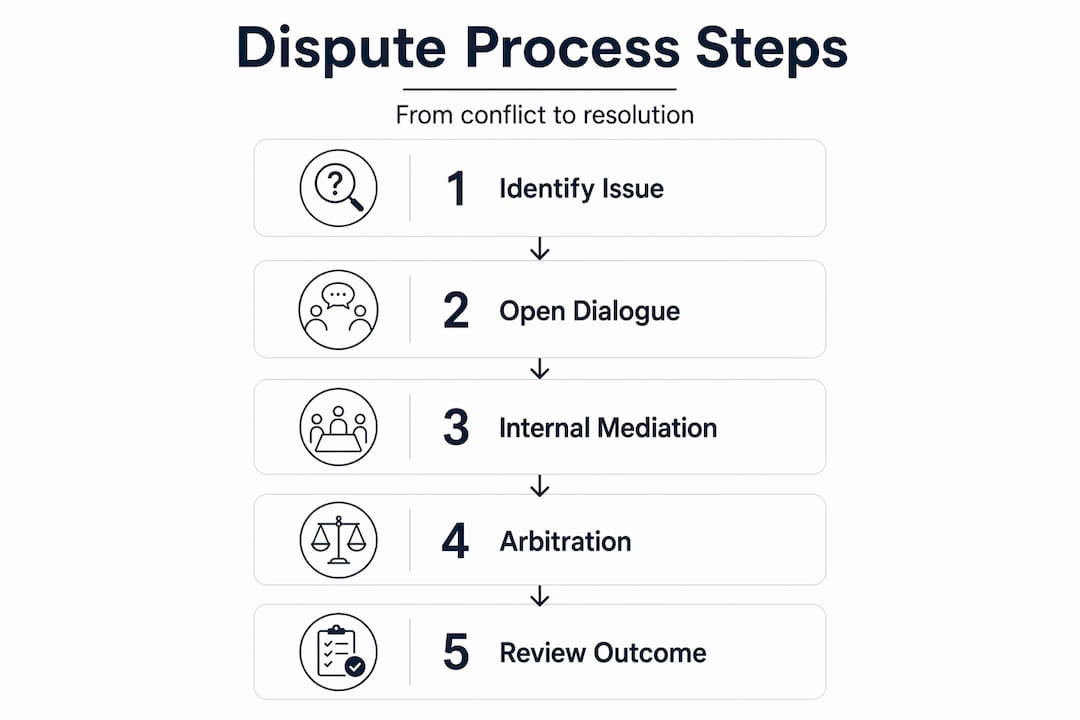
When a dispute cannot be resolved informally, the formal dispute resolution process for entrepreneurs should follow a clear sequence. Mediation’s flexibility and confidentiality make it the preferred first step, particularly for startups where preserving working relationships directly affects business value.
The step-by-step execution process is as follows:
- Issue written notice in accordance with the partnership agreement, clearly identifying the dispute and the relief sought.
- Attempt informal resolution during the cooling-off period through direct, interest-based negotiation.
- Engage a mediator if informal resolution fails, selecting one with relevant commercial or startup experience.
- Prepare for mediation by compiling documentation, setting realistic settlement targets, and identifying who will attend as decision-makers.
- Conduct mediation sessions, allowing the mediator to facilitate dialogue without imposing a decision.
- Document any agreement reached in mediation as a binding contract, signed by all parties.
- Proceed to arbitration only if mediation fails, recognising that the arbitration process for businesses is more formal and produces a binding, enforceable award.
- Resort to court proceedings only in emergencies such as injunctions needed to prevent imminent harm or asset dissipation.
Effective preparation for mediation includes these practical steps:
- Organise all relevant correspondence, contracts, and financial records chronologically.
- Prepare a written summary of your position, focusing on interests rather than demands.
- Confirm that the attending decision-maker has authority to settle without further approval.
- Anticipate the other party’s interests and identify areas where compromise is feasible.
Dispute system design consistently shows that starting with low-cost internal mediation prevents costly escalation to arbitration or litigation. The cost differential is significant. Mediation for a commercial dispute in Bosnia and Herzegovina typically costs a fraction of what arbitration proceedings require, and court litigation can extend for years within the local judicial system.
| Feature | Mediation | Arbitration |
|---|---|---|
| Cost | Lower, often fixed fees | Higher, varies by institution and complexity |
| Timeframe | Days to weeks | Months to over a year |
| Confidentiality | High, by agreement | Variable, often limited |
| Outcome control | Parties retain control | Arbitrator decides |
| Enforceability | Binding only if agreement is signed | Binding and court-enforceable |
| Relationship impact | Preserves relationships | Often adversarial |
For advice on corporate and technology legal matters that may intersect with dispute resolution, early legal involvement ensures that the chosen process aligns with the company’s contractual and regulatory obligations.
Pro Tip: Timebox each mediation session to no more than four hours. Fatigue reduces judgement quality and can cause parties to concede on matters they would otherwise contest reasonably. Scheduling a follow-up session is preferable to forcing resolution under exhaustion.
Common pitfalls and troubleshooting in the resolution process
Effective dispute settling for startups requires avoiding a set of recurring mistakes that consistently undermine resolution efforts. The most damaging errors include:
- Delaying recognition: Co-founders typically wait until conflict is deeply entrenched before seeking help, by which point options are narrower and costs are higher.
- Inadequate documentation: Verbal agreements and undocumented decisions become disputed facts when conflicts escalate.
- Inappropriate team involvement: Drawing employees into founder-level disputes creates loyalty conflicts and damages team culture.
- Choosing the wrong forum too early: Moving directly to arbitration or court before exhausting mediation wastes resources and destroys goodwill.
- Conflating business and personal grievances: Entrepreneurial conflict management requires separating personal frustrations from legitimate business disputes.
Creating a safe environment for mediation is critical. Parties must believe that participating in mediation will not be used against them later, whether in legal proceedings or in operational decisions within the company. Confidentiality agreements signed before mediation begins provide this assurance.
The question of managing legal disputes effectively is closely tied to organisational culture. Startups where leadership models constructive disagreement tend to surface conflicts earlier and resolve them faster.

Pro Tip: Schedule monthly co-founder sync meetings with a standing agenda item for raising concerns. Normalising the act of flagging issues early removes the stigma from conflict and prevents small irritants from compounding into company-threatening disputes.
Measuring success and ensuring sustainable dispute resolution culture
Implementing a dispute resolution process is only the beginning. Evaluating its effectiveness and embedding a culture of proactive conflict management is what delivers long-term protection for business continuity and growth.
Entrepreneurs should assess resolution effectiveness using the following criteria:
- Dispute frequency: Are disputes becoming less frequent over time, indicating that root causes are being addressed?
- Resolution cost: Is the average cost of resolving disputes declining as the process matures?
- Relationship quality: Do parties report improved working relationships following resolution?
- Time to resolution: Are disputes being resolved more quickly as the process becomes familiar?
- Satisfaction rates: Do all parties feel the process was fair and that their concerns were genuinely heard?
Evaluating dispute resolution systems by satisfaction, cost effectiveness, relationship quality, and dispute frequency is the standard recommended by negotiation research. These metrics should be reviewed at least annually.
| Metric | Measurement method | Target outcome |
|---|---|---|
| Dispute frequency | Number of formal disputes per quarter | Declining trend over 12 months |
| Resolution cost | Total legal and facilitation fees per case | Below industry benchmark |
| Time to resolution | Calendar days from notice to signed agreement | Under 60 days for mediation cases |
| Satisfaction rate | Post-resolution survey of all parties | Above 75% satisfaction |
| Relationship quality | Follow-up interviews at 90 days | Maintained or improved |
Leadership endorsement of the dispute resolution process is non-negotiable. When senior founders visibly respect and use the process, it signals to the entire organisation that conflict is manageable and that the company has the tools to handle it professionally.
Pro Tip: After each resolved dispute, conduct a brief retrospective to identify what process improvements would have made resolution faster or less costly. Feed those findings back into your partnership agreements and internal dispute protocols.
Rethinking dispute resolution: beyond traditional approaches for Bosnian entrepreneurs
There is a prevailing assumption among many entrepreneurs in Bosnia and Herzegovina that legal disputes are ultimately a matter for the courts. This assumption is worth challenging directly.
Court litigation in the Bosnian context is, for most startups, a last resort that functions more as a threat than a viable pathway. Proceedings are slow, costs are unpredictable, and the adversarial nature of litigation often destroys whatever commercial relationship remains between the disputing parties. Investors monitoring a startup in active litigation will note the distraction and the risk. Litigation signals internal dysfunction in a way that mediation never does.
The more consequential shift is conceptual. Founders who view disputes as threats tend to suppress them until they become crises. Founders who view disputes as signals of growth challenges tend to surface them earlier, which is when resolution is cheapest and most effective. This reframing is not idealism. It is a risk management position that experienced legal advisers consistently advocate.
Mediation-first dispute clauses and internal dispute committees are not bureaucratic additions to a startup structure. They are mechanisms that protect company value when relationships become strained, which they invariably do as stakes increase and pressures mount. An investor considering a Series A round in a Bosnian startup will find well-documented dispute resolution protocols reassuring rather than alarming.
Entrepreneurial conflict management at its best is proactive and institutionalised. It does not wait for a crisis. It anticipates the conditions under which conflict arises and builds the infrastructure to address it before costs escalate. Founders who engage with strategic legal dispute management early are, in practice, protecting their cap tables, their investor relationships, and their own equity positions.
How legal expertise supports your dispute resolution strategy
Navigating the dispute resolution process for entrepreneurs in Bosnia and Herzegovina requires more than good intentions and well-meaning conversations. It requires agreements that are legally sound, mediators who understand commercial dynamics, and founders who know their rights before they enter any resolution process.
Vucic.legal advises startups and growing businesses on drafting tailored dispute resolution clauses that reflect the specific legal framework in Bosnia and Herzegovina and align with international commercial standards. The firm supports founders in selecting appropriate mediators, structuring escalation processes, and training leadership teams in negotiation techniques for entrepreneurs. From initial clause drafting to managing live disputes, the approach prioritises practical outcomes over procedural formality. Explore the full range of legal services available or review specific guidance on legal dispute management and corporate law fundamentals to understand how professional legal support protects your business at every stage.
Frequently asked questions
What is the first step in an effective dispute resolution process for entrepreneurs?
The initial step is to diagnose dispute symptoms early and encourage informal, interest-based discussions to address issues before they require formal intervention.
Why is mediation preferred over litigation for startups?
Mediation’s flexibility and confidentiality make it significantly less costly, faster, and better at preserving business relationships than court proceedings, which is critical for startups with ongoing partnerships.
How should startup founders prepare for mediation sessions?
Founders should organise clear documentation, confirm that the attending representative has full settlement authority, and set realistic settlement targets before any mediation session begins.
When should entrepreneurs consider exiting a partnership instead of resolving disputes?
Exit is the appropriate course when contempt or irreconcilable visions are present, or when one partner is no longer genuinely engaged in the business.
How can entrepreneurs maintain a sustainable culture of dispute resolution?
By evaluating resolution systems regularly via satisfaction rates, costs, and relationship quality, and by providing ongoing training that embeds proactive conflict management into company culture.