What is corporate restructuring: a guide for business leaders

TL;DR:Corporate restructuring involves significant legal, financial, and operational changes to a company and requires formal approval and compliance. Proper planning, early legal counsel engagement, and phased communication are essential to ensure successful implementation. In Bosnia and Herzegovina, dual-entity legal structures demand coordinated legal and regulatory efforts to navigate complexities effectively.
Corporate restructuring is defined as a significant, non-routine change to a company’s financial obligations, internal operations, or legal structure, undertaken to resolve financial distress or reposition the business for improved performance. The process typically requires formal approval from boards, creditors, or shareholders, and carries material legal, regulatory, and tax consequences that demand careful planning. For business leaders operating across borders, particularly in markets such as Bosnia and Herzegovina, understanding the full scope of restructuring is the foundation of any credible execution plan. This guide covers the corporate restructuring definition, its principal types, the legal process, change management requirements, and region-specific considerations for international companies.
What is corporate restructuring and why does it matter?
Corporate restructuring is the deliberate modification of a company’s financial, operational, or organisational structure to address a specific business problem or opportunity. The trigger may be financial distress, a shift in market conditions, a merger or acquisition, or a decision to exit a particular business line. What distinguishes restructuring from ordinary management decisions is its scale and formality. Mergers or going-private transactions typically require a supermajority shareholder vote ranging from 67% to 90%. That threshold reflects the gravity of the change and the legal exposure it creates for the company and its directors.

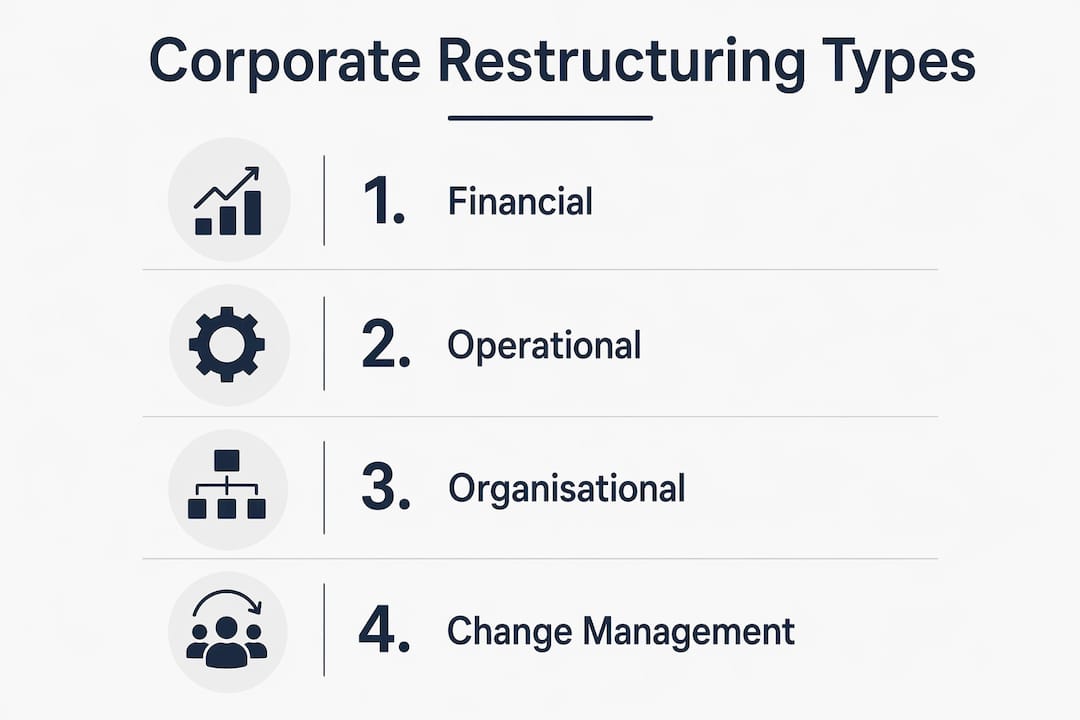
The corporate restructuring definition in legal practice encompasses three distinct categories: financial, operational, and organisational. Each addresses a different layer of the business. Financial restructuring modifies the capital structure, typically by renegotiating debt terms, converting debt to equity, or raising new capital. Operational restructuring targets internal processes, cost structures, and business unit performance. Organisational restructuring alters the legal entity structure, management hierarchy, or ownership arrangements. Understanding which category applies to a given situation determines which advisors, regulators, and approval processes are relevant.
Why is corporate restructuring important? Because the alternative to a managed restructuring is usually an unmanaged one. Companies that delay restructuring until creditors or regulators force the issue lose control of the process, the timeline, and frequently the outcome. A proactive restructuring, executed with proper legal and financial advice, preserves optionality and protects shareholder value.
What are the main types of corporate restructuring?
The three principal types of corporate restructuring serve different objectives and carry different legal implications.
Financial restructuring
Financial restructuring addresses the liability side of the balance sheet. It includes debt rescheduling, debt-for-equity swaps, refinancing, and capital injections. The goal is to reduce the cost of capital or extend the runway available to the business. This type of restructuring almost always involves creditor negotiations and, depending on the jurisdiction, court supervision or regulatory notification.
Operational restructuring
Operational restructuring targets the cost base and revenue model. Common measures include closing underperforming business units, renegotiating supplier contracts, consolidating facilities, and redesigning internal processes. The legal dimension here involves employment law, contract termination rights, and regulatory licences attached to specific operations.
Organisational restructuring
Organisational restructuring changes the legal and governance architecture of the business. This includes mergers, demergers, spin-offs, changes to the holding structure, and management buyouts. Each of these transactions carries distinct corporate law implications and requires careful documentation, regulatory filings, and often shareholder approval.
| Type | Primary focus | Typical approval required |
|---|---|---|
| Financial | Debt and equity structure | Creditors, board, shareholders |
| Operational | Costs, processes, business units | Board, regulators (sector-specific) |
| Organisational | Legal entities, ownership, governance | Shareholders, regulatory bodies |
A critical risk cuts across all three types. Lack of change management for employee anxiety is a primary cause of failed restructuring implementations. The financial and legal mechanics of a restructuring plan can be technically sound while the execution fails because the human dimension was treated as secondary.
Pro Tip: Before classifying a restructuring as purely financial or operational, map the downstream effects on employment contracts, regulatory licences, and entity-level obligations. The classification determines the legal process, not just the advisory team.
Which legal and regulatory steps are crucial in the corporate restructuring process?
The corporate restructuring process follows a consistent multi-step framework. Skipping or compressing any phase increases the risk of plan failure under creditor, regulator, or shareholder scrutiny. Neglecting legal filings and compliance can lead to dissolution, fines, or unenforceable contracts. The sequence below reflects established practice across European jurisdictions, including Bosnia and Herzegovina.
- Problem assessment. Define the specific financial, operational, or structural problem with precision. Vague problem statements produce vague plans. Engage legal counsel and financial advisors at this stage, not after a plan has been drafted.
- Modelling alternatives. Before committing to a restructuring path, model the financial and legal consequences of each available option. This includes stress-testing assumptions about creditor behaviour, regulatory timelines, and tax treatment.
- Drafting the formal plan. The restructuring plan must include financial projections, legal steps, regulatory notifications, and a communication strategy. Each element requires input from legal counsel to confirm enforceability and compliance.
- Securing approvals. Depending on the type of restructuring, approvals may be required from the board of directors, shareholders (potentially by supermajority), creditors, competition authorities, and sector regulators. Identifying all required approvals early prevents delays that can destabilise the process.
- Execution and stabilisation. Implementation requires coordinated action across legal, finance, human resources, and operations. Legal counsel must monitor compliance with filing deadlines, contractual obligations, and regulatory conditions throughout this phase.
Tax implications deserve particular attention during plan design. The structure of a debt-for-equity swap, for example, can produce taxable income at the entity level in some jurisdictions. In Bosnia and Herzegovina, the interaction between entity-level taxation and the dual-entity structure of the Federation and Republika Srpska adds a layer of complexity that requires local legal expertise. Leaders should treat regulatory compliance as a design constraint, not an afterthought.
Pro Tip: Engage legal counsel before the first internal planning meeting, not after the plan is drafted. Early involvement transforms legal advice from a checkpoint into a structural input that shapes the plan itself.
How to manage organisational change effectively during restructuring
Restructuring creates uncertainty for every level of the organisation. Employees, middle managers, and senior leaders all experience a period of reduced clarity about roles, reporting lines, and job security. That uncertainty, if unmanaged, translates directly into reduced productivity and increased attrition.
The most common mistake in managing this phase is communicating too early or too broadly. Communication during restructuring must be sequenced: engage key stakeholders early, and postpone broad employee communication until final plans are ready to prevent widespread anxiety. Announcing a restructuring before the plan is finalised creates a vacuum that rumour fills. The result is a workforce focused on self-preservation rather than business continuity.
A second common error is the use of corporate euphemisms. Leaders must avoid language such as “organisational optimisation” during layoffs, as employees recognise the gap between language and reality, and that gap erodes trust in leadership. Honest, direct communication about what is changing, why, and what it means for specific groups is consistently more effective than carefully managed messaging.
“Protecting productivity during restructuring requires defining temporary decision rights explicitly. Without clarity on who decides what during the transition, operational continuity deteriorates even when the restructuring plan itself is sound.”
The concept of productivity protection is underappreciated in most restructuring guides. Defining temporary decision rights during the transition period prevents the operational discontinuity that occurs when employees are uncertain whether their authority has changed. This is a structural intervention, not a cultural one, and it belongs in the restructuring plan alongside the financial and legal steps.
When workforce reductions are under consideration, modelling alternatives before layoffs is both a financial and a cultural discipline. Hiring freezes, furloughs, and voluntary separation packages frequently achieve the same cost reduction with significantly less damage to retention and organisational capability.
Practical advice for handling restructuring in Bosnia and Herzegovina
Bosnia and Herzegovina presents a specific set of legal and regulatory conditions that international companies must account for when planning a restructuring. The country operates under a complex constitutional structure, with the Federation of Bosnia and Herzegovina and Republika Srpska each maintaining separate company law, tax administration, and court systems. A restructuring that is legally straightforward in a unitary jurisdiction may require parallel filings, separate regulatory notifications, and coordinated legal representation in both entities.
Key considerations for international companies include:
- Entity-level compliance. Company law obligations, including shareholder meeting requirements, filing deadlines, and capital maintenance rules, apply separately in each entity. A restructuring involving a company registered in the Federation must comply with Federation company law, regardless of where the parent company is domiciled.
- Employment law obligations. Workforce restructuring in Bosnia and Herzegovina triggers specific consultation and notification requirements under applicable labour legislation. These obligations apply before any redundancy decisions are communicated to employees.
- Tax structuring. The tax treatment of debt forgiveness, asset transfers, and equity changes differs between the two entities and requires advice from advisors with local expertise. Cross-border transactions involving Bosnian entities also engage transfer pricing rules and withholding tax obligations.
- Governance documentation. Any change to the ownership structure, management board, or registered activities of a Bosnian company requires notarised documentation and registration with the relevant court registry. Delays in registration can affect the legal validity of downstream transactions.
- Stakeholder communication. In cross-border contexts, avoiding corporate euphemisms during workforce changes is particularly important. Employees and local stakeholders in Bosnia and Herzegovina respond to direct, factual communication. Ambiguous messaging creates legal risk as well as reputational damage.
Pro Tip: Schedule a joint meeting between ownership, local legal counsel, and financial advisors before any restructuring plan is drafted. Early advisory alignment reduces the risk of plan collapse when the plan reaches regulatory or creditor review.
Key takeaways
Corporate restructuring succeeds when legal compliance, financial modelling, and change management are treated as equally critical disciplines from the outset.
| Point | Details |
|---|---|
| Definition and scope | Corporate restructuring covers financial, operational, and organisational changes, each with distinct legal approval requirements. |
| Supermajority thresholds | Major transactions such as mergers may require shareholder approval of 67%–90%, making early legal planning non-negotiable. |
| Sequential communication | Broad employee communication should follow plan finalisation, not precede it, to prevent operational disruption. |
| Bosnia and Herzegovina complexity | Dual-entity legal structures require parallel filings and local legal expertise in both the Federation and Republika Srpska. |
| Early advisory alignment | Engaging legal counsel before plan drafting reduces the risk of compliance failures and plan collapse under scrutiny. |
The groundwork is where restructurings are won or lost
Having advised on corporate restructuring projects across multiple jurisdictions, the pattern I observe most consistently is this: the plans that fail do not fail at execution. They fail because the internal groundwork was inadequate before the plan was ever presented to creditors, regulators, or shareholders. Leaders underestimate how much scrutiny a restructuring plan attracts once it is in circulation. Every assumption is tested. Every legal step is examined. Plans built on incomplete information collapse at precisely the moment when stability matters most.
The second observation concerns communication. Most leadership teams treat communication as a single event, a town hall or a company-wide announcement, rather than a sequenced process. The organisations that manage restructuring most effectively treat communication as a phased discipline with different messages for different audiences at different stages. That approach is not about managing perception. It is about maintaining the operational continuity that the restructuring is designed to protect.
The third point is about the composition of the advisory team. Financial advisors and legal counsel working in isolation from each other produce plans with internal contradictions. The tax structure conflicts with the legal entity design. The creditor negotiation strategy conflicts with the shareholder approval timeline. Cross-functional collaboration between advisors, coordinated from the earliest planning stage, is the single most reliable predictor of a restructuring that reaches completion without material revision.
— Franjo
How Vucic supports business leaders through restructuring
Corporate restructuring in Bosnia and Herzegovina requires legal counsel that understands both the technical requirements of company law and the practical realities of operating in a dual-entity jurisdiction.
Vucic provides corporate and commercial legal services to international companies, investors, and leadership teams navigating restructuring processes in Bosnia and Herzegovina and across European markets. The firm’s work covers entity restructuring, regulatory compliance, cross-border transactions, and governance documentation. For companies requiring legal support that is grounded in local regulatory knowledge and aligned with international business standards, Vucic offers the depth of expertise that complex restructuring projects demand. Contact Vucic to discuss the legal framework for your restructuring before the planning process begins.
FAQ
What is the corporate restructuring definition in legal terms?
Corporate restructuring is a significant, non-routine change to a company’s financial obligations, operations, or legal structure, typically requiring formal approval from boards, creditors, or shareholders.
What are the main types of corporate restructuring?
The three main types are financial restructuring (debt and equity changes), operational restructuring (process and cost changes), and organisational restructuring (legal entity and governance changes).
Why is corporate restructuring important for business leaders?
Proactive restructuring preserves management control over the process and timeline. Companies that delay until creditors or regulators intervene lose both optionality and negotiating position.
How do you handle corporate restructuring in Bosnia and Herzegovina?
International companies must account for the dual-entity legal structure, with separate company law, tax administration, and court registries in the Federation and Republika Srpska. Parallel legal representation in both entities is standard practice.
What is the most common reason corporate restructuring fails?
The most common cause of failure is inadequate internal groundwork. Plans built on incomplete financial or legal information collapse under creditor, regulator, or shareholder scrutiny before execution begins.