Family business legal challenges: a practical guide

TL;DR:Family business legal challenges often stem from governance gaps, succession issues, and regulatory complexities that threaten stability. Proactive legal structuring, including detailed operating agreements and pre-defined dispute resolution processes, is essential for long-term preservation. Building resilient governance architectures helps family firms overcome conflicts and regulatory pressures across generations.
Family business legal challenges are defined as the governance, succession, and dispute resolution issues that uniquely affect family-owned enterprises, often because personal relationships and commercial obligations occupy the same legal structure. These challenges are particularly acute in Bosnia and Herzegovina, where company law, inheritance rules, and regulatory requirements interact in ways that can destabilise even well-established family firms. Governance architecture, succession frameworks, and conflict management mechanisms are the three domains where legal risk concentrates most heavily. Addressing them proactively is not optional for businesses seeking continuity across generations.
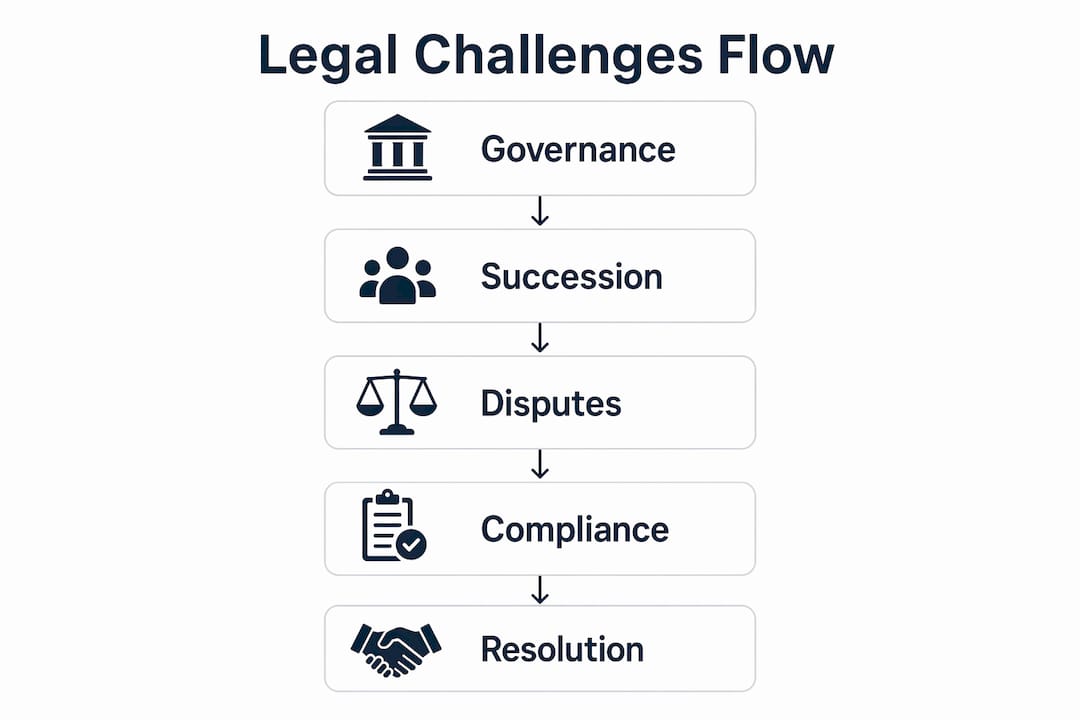
What are the main family business legal challenges in governance?
Governance structure is the single greatest determinant of whether legal issues in family business remain manageable or escalate into litigation. The two most common models are majority-rule entities, typically limited liability companies with a controlling shareholder, and equal-ownership structures where two or more family members hold identical stakes. Each model carries distinct legal risks that must be addressed in the operating agreement before conflict arises.

Equal ownership arrangements present the most structurally dangerous configuration. In two-member LLCs with 50/50 ownership and no contractual tie-breaker, deadlock is structurally possible, leading to operational paralysis and dissolution risk. This means that without a defined dispute resolution mechanism in the founding documents, a single disagreement between co-owners can render the business legally ungovernable.
Majority-rule structures offer more operational resilience but introduce a different set of risks. Minority shareholders in family firms are particularly vulnerable to oppression, exclusion from dividends, and dilution without adequate protective provisions. The 2026 case of Donahue v. Donahue illustrates this clearly: a three-member LLC with majority voting was not dissolved despite significant interpersonal conflict because operational deadlock was absent. Courts require a structural logjam, not merely a dysfunctional relationship, before granting dissolution. This distinction has direct implications for how family businesses in Bosnia and Herzegovina should draft their founding acts.
| Governance model | Primary legal risk | Key protective mechanism |
|---|---|---|
| 50/50 equal ownership | Operational deadlock and dissolution | Contractual tie-breaker or casting vote provision |
| Majority-rule LLC | Minority oppression and exclusion | Minority protection clauses and exit rights |
| Multi-generational trust | Outdated deed provisions | Regular deed review and amendment protocols |
| Sole family director | Succession gap on incapacity | Deputy director appointment and power of attorney |
Pro Tip: Draft governance documents before the first disagreement, not after. Litigation strategies for deadlock claims focus heavily on the operating agreement terms, particularly voting thresholds and exit mechanisms. A well-drafted agreement is the most cost-effective legal instrument a family business can hold.
How does succession planning create legal risk in family businesses?
Family business succession planning is the process of transferring ownership and operational control between generations in a legally structured and tax-efficient manner. Most legal disputes in this area do not arise from bad intentions. They arise from structural gaps: equal financial inheritance without defined operational roles, vague valuation terms in buy/sell agreements, and governance documents that have not been updated to reflect the current generation’s realities.
Equal financial inheritance without defined operational roles frequently produces governance friction that can cause business decline. When three siblings inherit equal shares but only one manages the business, the non-operating owners retain legal rights over decisions they do not understand and bear no daily responsibility for. This misalignment between economic interest and operational authority is the structural origin of most common family business disputes.
Buy/sell agreements are the standard legal tool for managing ownership transitions, but they carry their own risks when poorly drafted. Terms such as “fair value” versus “fair market value” create ambiguities that have produced litigation, as demonstrated in Ferolito v. Arizona Beverages (2014). The valuation methodology must be explicit, regularly reviewed, and agreed upon before a triggering event occurs, not negotiated under pressure during a dispute.
Ownership transfers in family businesses also trigger specialised tax rules in Bosnia and Herzegovina, including capital gains treatment and transfer pricing considerations for related-party transactions. Transfers between family members trigger specialised tax rules and valuation factors that affect both legal and financial outcomes. Engaging tax counsel alongside legal counsel at the planning stage avoids costly restructuring later.
Key succession planning best practices for family businesses include:
- Assign operational authority explicitly rather than distributing it equally among all heirs
- Define valuation methodology in buy/sell agreements and review it every three years
- Use instalment sales or hybrid transfer approaches to manage liquidity and tax exposure
- Separate financial inheritance from governance rights through share class structures
- Document succession intent in a formal family charter that complements the legal operating agreement
Pro Tip: Governance documentation must be in place before any ownership transfer is executed. Disputes arise when governance systems built on trust fail under conflict. Rule-based architecture must replace relational assumptions before the transfer, not after.
What escalates family business disputes and how are they resolved?
The most common causes of escalating legal conflict in family enterprises are governance friction, valuation disagreements, operational deadlocks, and the absence of contractual exit mechanisms. These are not interpersonal failures. They are structural deficiencies that become visible under pressure. Understanding how to resolve family business conflicts requires distinguishing between relational approaches and legal remedies, and knowing when each is appropriate.
The standard progression of dispute resolution in family business contexts follows a defined sequence:
- Negotiation. Direct dialogue between the parties, typically facilitated by legal counsel, to reach a consensual resolution without third-party intervention.
- Mediation. A neutral third party assists the parties in reaching a voluntary settlement. Mediation preserves relationships and is significantly less costly than litigation. Negotiation and mediation consistently produce better outcomes and less stress than adversarial proceedings in family law contexts.
- Arbitration. A binding decision is issued by a private arbitral tribunal. Arbitration is faster than court proceedings and allows the parties to select an arbitrator with relevant commercial expertise.
- Judicial dissolution. A court order dissolving the entity. This remedy is reserved for cases of genuine structural incapacity. As Donahue v. Donahue confirms, judicial dissolution requires an unmovable operational logjam, not merely interpersonal dysfunction.
- Structural remedies. Court-ordered buy-outs, appointment of a receiver, or forced share transfers where dissolution is not warranted but governance has failed.
| Dispute resolution method | Primary advantage | Primary limitation |
|---|---|---|
| Negotiation | Low cost, preserves relationships | Requires good faith from all parties |
| Mediation | Flexible, confidential, non-binding | No enforceable outcome without agreement |
| Arbitration | Binding, expert decision-maker | Cost and procedural formality |
| Judicial dissolution | Definitive resolution | High threshold, destroys the enterprise |
| Structural remedy | Preserves business continuity | Requires court involvement and legal costs |
The practical implication for family business owners in Bosnia and Herzegovina is that the dispute resolution process should be contractually defined in the operating agreement before any conflict arises. Specifying the sequence of remedies and the applicable arbitral rules in advance removes ambiguity and reduces the cost of resolution significantly.
How does regulatory complexity affect family business compliance?
Regulatory complexity imposes a disproportionate compliance burden on family businesses because governance authority is concentrated among a small number of family members who must simultaneously manage operations and monitor regulatory developments. Regulatory focus dispersion imposes greater compliance burdens on family firms due to concentrated decision-making, a dynamic that non-family firms with professional management structures handle more effectively.
The attention-based view of regulatory compliance explains why this matters operationally. When regulations across tax, employment, environmental, and corporate law change at different rates and in different directions, family business owners must distribute their limited attention across multiple compliance domains simultaneously. Family firms with concentrated governance endure reduced productivity and growth amid regulatory heterogeneity, shifting focus from value creation to reactive compliance.
In Bosnia and Herzegovina, the regulatory environment adds a further layer of complexity. Entity-level rules differ between the Federation of Bosnia and Herzegovina and Republika Srpska, meaning that family businesses operating across both entities face two distinct regulatory regimes for company registration, labour law, and tax compliance. This jurisdictional fragmentation amplifies the governance stress that regulatory dispersion already creates.
Family businesses can mitigate these risks by appointing dedicated compliance oversight and expanding board expertise. Practical measures include designating a compliance officer from outside the family, establishing a regulatory review calendar, and engaging external counsel for periodic compliance audits. These structural adjustments allow the family’s governance attention to remain focused on strategic decisions rather than reactive regulatory management. Guidance on compliance for business growth demonstrates how regulatory discipline can function as a competitive advantage rather than a cost centre.
Best practices for designing governance systems that reduce legal risk
Effective family business governance systems are built on documented authority, defined exit mechanisms, and regular review cycles. The most significant legal risks in family enterprises arise not from external threats but from internal governance gaps that were never addressed in founding documents. Governance documents must evolve regularly with family business growth and generational changes to prevent structural gaps that invite legal conflict.
Designing governance systems that reduce legal exposure requires attention to several interconnected elements. A comprehensive operating agreement or trust deed must define voting thresholds, reserved matters requiring unanimous consent, and the process for amending the document itself. Minority owner protections, including pre-emption rights, tag-along rights, and anti-dilution provisions, must be explicitly stated rather than assumed. Exit mechanisms, whether voluntary buy-out rights or compulsory transfer provisions, must include a defined valuation methodology to prevent disputes at the point of departure.
Independent legal counsel plays a critical role in this process. Family members negotiating governance terms with each other face inherent conflicts of interest. Engaging separate counsel for each principal, particularly during succession planning or dispute resolution, ensures that each party’s rights are properly documented and that no single family member’s interests dominate the governance architecture. Formalised communication channels, including board minutes, shareholder resolutions, and written notices, create an evidentiary record that protects all parties if a dispute later arises.
Key design principles for family business governance include:
- Draft a comprehensive operating agreement that addresses deadlock, succession, and exit from the outset
- Include minority owner protections as standard provisions, not negotiated additions
- Define valuation methodology for buy/sell triggers and review it on a fixed schedule
- Appoint independent directors or advisers to provide governance oversight outside the family
- Update all governance documents following any significant change in ownership, management, or family structure
Guidance on protecting your business through sound legal structuring provides a practical starting point for family business owners reviewing their current governance arrangements.
Key takeaways
Family business legal challenges are best managed through proactive governance architecture, clearly documented succession frameworks, and contractually defined dispute resolution mechanisms rather than reactive litigation.
| Point | Details |
|---|---|
| Governance structure determines risk | Equal ownership without a tie-breaker creates deadlock risk; majority-rule structures require minority protections. |
| Succession planning requires legal precision | Vague valuation terms and undefined operational roles are the primary sources of succession disputes. |
| Dispute resolution should be pre-agreed | Specifying negotiation, mediation, and arbitration sequences in the operating agreement reduces resolution costs significantly. |
| Regulatory complexity demands structural response | Appointing compliance officers and expanding board expertise mitigates the disproportionate burden on family governance. |
| Governance documents must be maintained | Outdated operating agreements and trust deeds are the structural origin of most family business legal conflicts. |
Why proactive legal architecture matters more than reactive dispute management
Having worked with family businesses across Bosnia and Herzegovina and the broader European market, I have observed a consistent pattern: the families who face the most damaging legal disputes are rarely those who disagreed the most. They are the ones who documented the least.
The conventional approach to family business governance treats legal documentation as a formality to be completed at incorporation and revisited only when a problem surfaces. This is the wrong sequence. By the time a dispute reaches mediation or litigation, the governance gaps that caused it have already been exploited. The operating agreement that was adequate for two siblings in their thirties is rarely adequate for their children and spouses a generation later.
What I find most instructive about cases like Donahue v. Donahue is not the outcome but the architecture that prevented dissolution. The majority-rule structure gave the business a mechanism to continue functioning despite significant relational breakdown. That mechanism was not created during the dispute. It was created at founding. The lesson is not that family businesses should avoid conflict. It is that they should build structures capable of surviving it.
The intertwining of personal and commercial relationships in family enterprises creates a specific legal vulnerability that professional management structures do not face. A shareholder dispute between unrelated parties is resolved through contract. The same dispute between siblings carries reputational, emotional, and relational dimensions that make purely adversarial resolution destructive. Hybrid models that combine clear legal authority with structured mediation protocols are consistently more effective than either pure relational trust or pure contractual rigidity.
My advice to family business owners is straightforward: engage specialised legal counsel before the first generation transfer, not after the first dispute. The cost of a well-drafted governance framework is a fraction of the cost of a single contested dissolution proceeding. Governance architecture is not a constraint on family relationships. It is the structure that allows those relationships to survive commercial pressure.
— Franjo
How Vucic supports family businesses with complex legal challenges
Family businesses operating in Bosnia and Herzegovina face a distinctive combination of governance complexity, succession risk, and regulatory fragmentation. Vucic provides specialised legal advisory services covering governance structuring, succession planning, and dispute resolution, with a focus on preserving business continuity and protecting family relationships through sound legal architecture.

Whether you are structuring a first-generation transfer, addressing a governance deadlock, or preparing for cross-border expansion, Vucic’s approach prioritises practical solutions aligned with your business realities. The firm’s strategic legal services are designed for family business owners who require precise, confidential, and commercially grounded legal counsel. For businesses with international dimensions, Vucic also provides cross-border legal counsel tailored to the regulatory complexity of operating across multiple jurisdictions.
FAQ
What are the most common legal issues in family businesses?
The most common legal issues in family businesses are governance deadlocks, succession disputes, and valuation disagreements in buy/sell agreements. These issues arise primarily from outdated or incomplete governance documents rather than from external legal changes.
When does a court grant judicial dissolution of a family business?
Judicial dissolution is granted only when an LLC experiences a structural operational logjam, not simply interpersonal conflict. As confirmed in Donahue v. Donahue (2026), courts require evidence that the business cannot function, not merely that the owners disagree.
How should family businesses structure succession planning to avoid disputes?
Succession planning should assign operational authority explicitly, define valuation methodology in buy/sell agreements, and separate financial inheritance from governance rights through share class structures. Governance documentation must be in place before any ownership transfer is executed.
What dispute resolution method is most appropriate for family business conflicts?
Mediation is the most appropriate first step for most family business disputes because it preserves relationships, maintains confidentiality, and produces faster outcomes than litigation. Arbitration is preferable when a binding decision is required and the parties wish to avoid court proceedings.
How does regulatory complexity specifically affect family businesses in Bosnia and Herzegovina?
Family businesses in Bosnia and Herzegovina face dual regulatory regimes across the Federation and Republika Srpska, which amplifies the compliance burden on concentrated family governance. Appointing a dedicated compliance officer and engaging external legal counsel for periodic audits are the most effective structural responses.