Why real estate laws affect companies: a 2026 guide

TL;DR:Real estate laws shape how companies acquire, hold, and transfer property assets across European markets.Understanding these laws early helps firms avoid delays, limit liabilities, and optimize financing conditions.
Real estate law is defined as the body of statutes, regulations, and case law that governs how property is acquired, held, financed, and transferred by legal entities. For companies operating across European markets, these rules are not peripheral compliance matters. They determine corporate structure, shape financing capacity, and set the boundaries of operational activity at every stage of a business’s growth.
The impact of real estate laws reaches well beyond property transactions. Regulatory frameworks such as CRD VI and Basel IV, the EU Short-term Rentals Regulation, and jurisdiction-specific zoning codes each impose binding constraints on how companies deploy capital and organise their assets. Business leaders who treat real estate law as a back-office concern routinely encounter financing delays, structural liabilities, and project costs that could have been avoided with earlier legal planning.
Why real estate laws affect companies: corporate structure and risk
Real estate law shapes corporate structure by determining how companies hold property assets and allocate liability between entities. The most common response is to place real estate in a separate legal entity, such as a special purpose vehicle (SPV) or holding company, which isolates property-related liabilities from the operating business. This separation protects the trading entity from creditor claims arising from the real estate asset and vice versa.
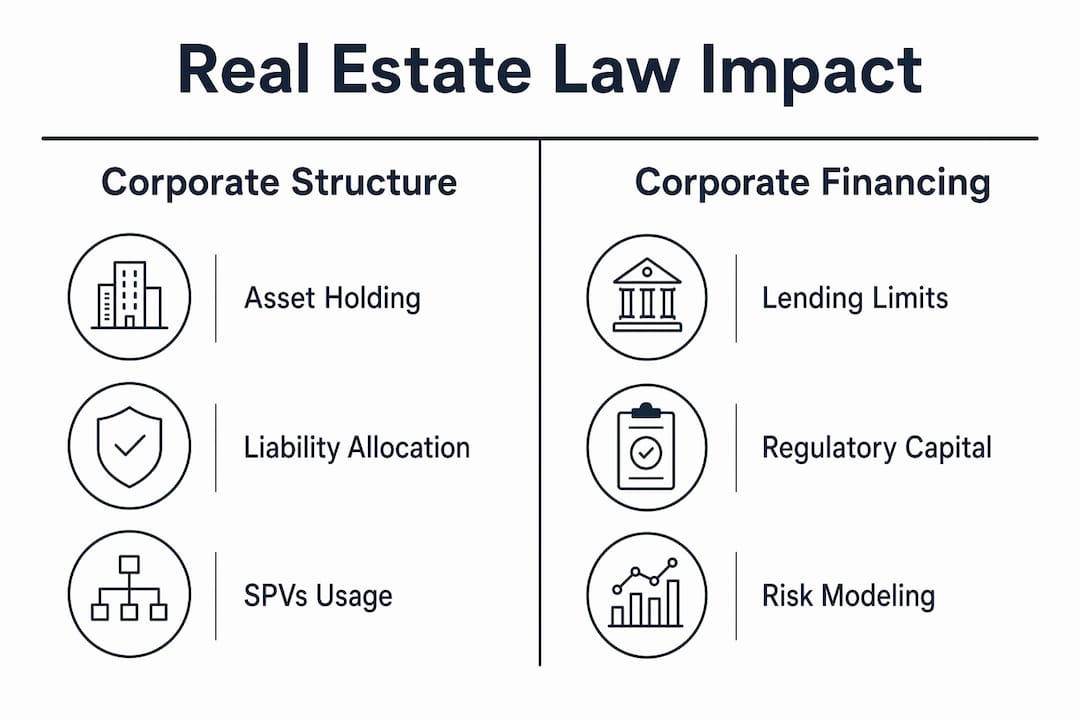
Improper structuring carries concrete financial consequences. Inadequate entity design can expose an operating company to millions in losses when a property asset faces litigation, enforcement action, or insolvency proceedings. Lenders are particularly attentive to this point. Many financing delays arise directly from a failure to meet lender governance standards, including requirements for bankruptcy-remote status in the holding entity.
Entity structuring also governs investor relations and dispute resolution. When multiple parties co-invest in a real estate asset, the legal framework of the holding entity determines voting rights, exit mechanisms, and liability allocation. Choosing the wrong structure at the outset creates governance disputes that are expensive to resolve and can block refinancing or sale.
Key considerations when structuring real estate entities include:
- Liability separation: SPVs prevent operating business liabilities from contaminating property assets, and property liabilities from reaching the trading company.
- Lender requirements: Financiers typically require clean entity structures with defined governance, clear ownership chains, and bankruptcy-remote features before committing capital.
- Investor governance: Partnership agreements and shareholder arrangements must align with the legal framework of the jurisdiction where the asset sits.
- Tax efficiency: Entity choice affects stamp duty, VAT treatment, and capital gains exposure across European jurisdictions.
Pro Tip: Structure the holding entity before approaching lenders. Attempting to restructure mid-financing process adds cost, delays completion, and signals governance weakness to counterparties.
How do real estate regulations affect corporate financing?
Real estate regulations directly constrain how much capital banks can deploy into property lending and on what terms. CRD VI and Basel IV, both taking effect from 2026, tighten regulatory capital requirements for real estate exposures. The practical result is a €250bn funding gap in European real estate financing, as traditional lenders reduce exposure to comply with the new rules. That gap forces companies to seek alternative capital sources, including debt funds, insurance capital, and mezzanine lenders, each with different pricing and covenant structures.

The EU Short-term Rentals Regulation, which introduces transparency and registration requirements for platforms and hosts, adds a further layer of compliance cost for companies with hospitality or serviced accommodation assets. Investors who built return models on unregulated short-term rental income must now account for registration fees, data reporting obligations, and potential restrictions on rental nights. These changes alter net operating income projections and, by extension, the loan-to-value ratios lenders will accept.
| Regulatory factor | Impact on financing |
|---|---|
| CRD VI / Basel IV capital rules | Reduces bank lending capacity; raises cost of debt |
| EU Short-term Rentals Regulation | Alters income projections; affects LTV calculations |
| Energy performance standards | Increases capex requirements; affects covenant headroom |
| Zoning and density constraints | Limits development yield; changes equity return assumptions |
Modelling regulatory scenarios early in the underwriting phase is not optional. Energy performance standards and permitted density constraints change cost and revenue expectations in ways that directly affect financing covenants and equity returns. Companies that integrate these variables at feasibility stage avoid covenant breaches and equity shortfalls later in the project lifecycle.
Pro Tip: When preparing a financing package for a European real estate asset, include a regulatory risk schedule alongside the financial model. Lenders increasingly require this as part of credit committee submissions.
What operational constraints arise from real estate laws?
Real estate legal requirements impose direct operational constraints on companies, affecting where they can locate, how they can use premises, and what licences they must hold. EU housing and real estate regulations increase administrative burdens, creating delays and cost increases that affect project timelines and operational planning across European markets.
Licensing requirements vary significantly by jurisdiction. In many European countries, real estate businesses must hold firm-level licences, appoint qualified principal officers, and register branch offices separately. Failure to comply with these requirements can void transactions, attract regulatory penalties, and disqualify companies from bidding on certain asset classes. The licensing and regulatory requirements governing real estate transactions illustrate how granular these obligations become at the operational level.
Zoning and land-use laws convert what appear to be commercial assumptions into binding financial constraints. Planning and zoning uncertainties introduce litigation risk and delay costs that can freeze land purchases and halt project starts. A company acquiring a site for mixed-use development may find that permitted use classifications restrict the commercial component, reducing projected income and altering the entire business case.
Cross-jurisdictional complexity compounds these challenges for companies operating across European markets. Lease terms, tenant protections, and permitted assignment clauses differ materially between Bosnia and Herzegovina, Germany, Austria, and the Netherlands. A company applying a single lease template across multiple jurisdictions risks unenforceable provisions and disputes that require costly local litigation to resolve. Engaging legal expertise for European markets at the outset of any cross-border real estate programme is the most reliable way to avoid these outcomes.
How should companies approach real estate legal due diligence?
Legal due diligence in real estate is a repeatable workstream, not a one-time transaction check. Title defects, lease terms, and regulatory constraints require early and thorough examination to prevent late-stage redesigns and financing disruptions. Companies that treat due diligence as a pre-signing formality consistently encounter problems that could have been identified and resolved weeks earlier.
A structured due diligence process for corporate real estate should follow these steps:
- Title and ownership verification. Confirm clean title, identify encumbrances, and check for any prior claims or restrictions registered against the asset.
- Regulatory constraint mapping. Identify zoning classifications, permitted uses, energy performance obligations, and any pending planning applications affecting the site.
- Lease and occupancy analysis. Review all existing leases for assignment restrictions, break clauses, rent review mechanisms, and tenant protections under local law.
- Compliance sequencing. Map the order in which regulatory approvals, licences, and registrations must be obtained to avoid financing delays.
- Jurisdiction-specific legal review. Engage local counsel in each jurisdiction to identify rules that do not appear in standard due diligence checklists but carry material risk.
Planning for jurisdiction-specific differences is particularly critical in European markets, where cross-border legal complexity can affect deal timelines by months. Companies entering Bosnia and Herzegovina, for example, face a dual-entity legal system with distinct property registration processes in the Federation and Republika Srpska. Treating these as a single jurisdiction is a common and costly error.
Integrating legal risk into feasibility and underwriting models changes the quality of investment decisions. When regulatory classifications such as energy standards and density constraints are modelled early, capital allocation reflects actual project risk rather than optimistic assumptions. This approach reduces the frequency of late-stage renegotiations and protects equity returns.
Key takeaways
Real estate laws affect companies by determining how they structure assets, access financing, and manage operational compliance across every jurisdiction in which they hold property.
| Point | Details |
|---|---|
| Entity structuring is a legal requirement | SPVs and holding companies protect operating businesses and satisfy lender governance standards. |
| Regulatory capital rules tighten financing | CRD VI and Basel IV create a €250bn European funding gap, forcing companies to seek alternative capital. |
| Operational licences vary by jurisdiction | Licensing, zoning, and land-use rules differ materially across European markets and must be verified locally. |
| Due diligence is a repeatable process | Title checks, regulatory mapping, and lease analysis must occur at every acquisition or relocation, not just at signing. |
| Early legal integration protects returns | Modelling regulatory scenarios at feasibility stage prevents covenant breaches and equity shortfalls later. |
Real estate law as a strategic input, not a compliance cost
The companies I see manage real estate most effectively are not those with the largest legal budgets. They are the ones that treat legal analysis as an input to business decisions rather than a review of decisions already made. That distinction matters enormously in European markets, where regulatory change is accelerating and the consequences of late-stage legal problems are severe.
The introduction of CRD VI and Basel IV in 2026 is a clear example. Companies that anticipated the financing constraints these rules would create began restructuring their capital sources and entity designs in 2024 and 2025. Those that waited are now competing for a smaller pool of willing lenders at higher cost. The legal framework did not change the underlying asset quality. It changed the financing environment, and only those who read the regulatory direction early were positioned to respond.
Entity structuring deserves particular attention from business leaders who have historically held property in their operating company for simplicity. The liability exposure this creates is real, and the governance problems it causes when seeking external financing are predictable. Separating real estate into a dedicated holding structure is not a complex transaction. It is a straightforward legal step that most companies delay far longer than they should.
The broader point is that compliance integrated into strategy produces better outcomes than compliance bolted on after the fact. Regulatory requirements set the parameters within which profitable real estate activity is possible. Understanding those parameters early is a genuine competitive advantage, not a burden.
— Franjo
How Vucic supports companies with real estate legal strategy
Business leaders managing real estate assets across European jurisdictions require legal counsel that understands both the regulatory environment and the commercial pressures of corporate decision-making. Vucic provides corporate and real estate legal services covering entity structuring, compliance planning, transactional support, and cross-border regulatory analysis.

For companies entering Bosnia and Herzegovina or expanding across European markets, Vucic offers practical guidance on property risks and corporate structuring tailored to the specific legal requirements of each jurisdiction. The firm’s approach prioritises early legal integration, helping business leaders avoid the financing delays and compliance failures that arise from treating real estate law as an afterthought. Contact Vucic to discuss how legal structuring can support your real estate and corporate growth objectives.
FAQ
Why do real estate laws affect company financing?
Real estate laws set the regulatory capital requirements that govern bank lending, directly limiting how much debt companies can access for property assets. CRD VI and Basel IV rules, effective from 2026, have created a €250bn funding gap in European real estate financing.
What is an SPV and why do companies use one for real estate?
A special purpose vehicle (SPV) is a separate legal entity used to hold a real estate asset, isolating its liabilities from the operating business. Lenders typically require SPV structures with bankruptcy-remote features before committing financing to a real estate project.
How do zoning laws affect corporate real estate decisions?
Zoning laws define the permitted uses of a site, which directly affects income projections, development yield, and the viability of a business case. Planning uncertainty introduces litigation risk and delay costs that can freeze acquisitions and halt project starts.
What does legal due diligence cover in a real estate transaction?
Legal due diligence covers title verification, regulatory constraint mapping, lease analysis, compliance sequencing, and jurisdiction-specific legal review. Practitioners treat it as a repeatable workstream rather than a single pre-signing exercise.
How do real estate laws differ across European jurisdictions?
Real estate legal requirements vary materially between countries in areas including licensing, tenant protections, land registration, and permitted use classifications. Companies operating in Bosnia and Herzegovina face additional complexity from its dual-entity legal system, which applies distinct property rules in the Federation and Republika Srpska.