What is regulatory compliance: a guide for business leaders

TL;DR:Regulatory compliance involves continuously adhering to applicable laws, standards, and regulations across business functions.It requires integrated governance, active enforcement, and strong leadership support to manage risks effectively.
Regulatory compliance is an organisation’s commitment to adhering to all applicable laws, regulations, guidelines, and standards relevant to its business operations. As Microsoft Security defines it, this spans data protection, financial reporting, cybersecurity, environmental standards, labour practices, and anti-corruption obligations. For business leaders and compliance officers, particularly those operating across borders or entering markets such as Bosnia and Herzegovina, understanding what regulatory compliance requires is not optional. It is the foundation of legal risk control and long-term business credibility.
What is regulatory compliance and what laws does it cover?
Regulatory compliance is an ongoing process, not a one-time checklist. Thomson Reuters defines it as the continuous maintenance of adherence to laws, regulations, and industry standards relevant to business operations. That distinction matters because many organisations treat compliance as a project with an end date rather than a permanent operational function.

For companies doing business in Bosnia and Herzegovina, the regulatory landscape spans several distinct categories. The country operates under a complex constitutional structure, with separate entity-level laws in the Federation of Bosnia and Herzegovina and Republika Srpska, alongside state-level legislation. Foreign investors must map their obligations across all applicable layers.
The key regulatory areas that typically apply to businesses include:
- Data protection and privacy. Bosnia and Herzegovina has adopted data protection legislation aligned with European standards. Companies processing personal data must comply with local data protection rules, and those operating across EU borders must also address GDPR obligations directly.
- Financial reporting and anti-corruption. Companies are subject to accounting and audit requirements under entity-level laws. Anti-corruption obligations apply under both domestic criminal law and international frameworks, including the OECD Anti-Bribery Convention.
- Workplace safety and labour regulations. Labour law in Bosnia and Herzegovina is entity-specific. Employers must comply with rules on employment contracts, working hours, occupational safety, and collective agreements.
- Environmental, social, and governance (ESG) standards. ESG compliance is increasingly required for companies seeking international financing or operating in regulated sectors. ISO 14001 and related standards provide the relevant benchmarks.
- Trade and supply chain compliance. Import and export regulations, customs duties, and sanctions screening apply to companies with cross-border supply chains. Bosnia and Herzegovina’s status as a candidate for EU accession means alignment with EU trade rules is progressively expected.
- Sector-specific frameworks. Financial services firms must address banking and securities regulations. Technology companies face obligations under cybersecurity and electronic communications law. Frameworks such as PCI DSS, HIPAA, and GDPR illustrate how sector-specific compliance extends well beyond general corporate law.
The international standard ISO 37301 provides a recognised framework for compliance management systems. It defines the requirements for establishing, developing, implementing, evaluating, and maintaining an effective compliance programme across any organisation.
| Regulatory area | Primary obligation | Applicable standard or authority |
|---|---|---|
| Data protection | Lawful processing of personal data | Local data protection law, GDPR |
| Financial reporting | Accurate accounts and audit | Entity-level accounting laws |
| Anti-corruption | Prohibition on bribery and facilitation payments | OECD Convention, domestic criminal law |
| Labour and workplace safety | Employment contracts, safe working conditions | Entity-level labour codes |
| ESG and environmental | Environmental impact management | ISO 14001, sector regulators |
| Trade compliance | Customs, sanctions, export controls | State-level customs law, EU alignment |
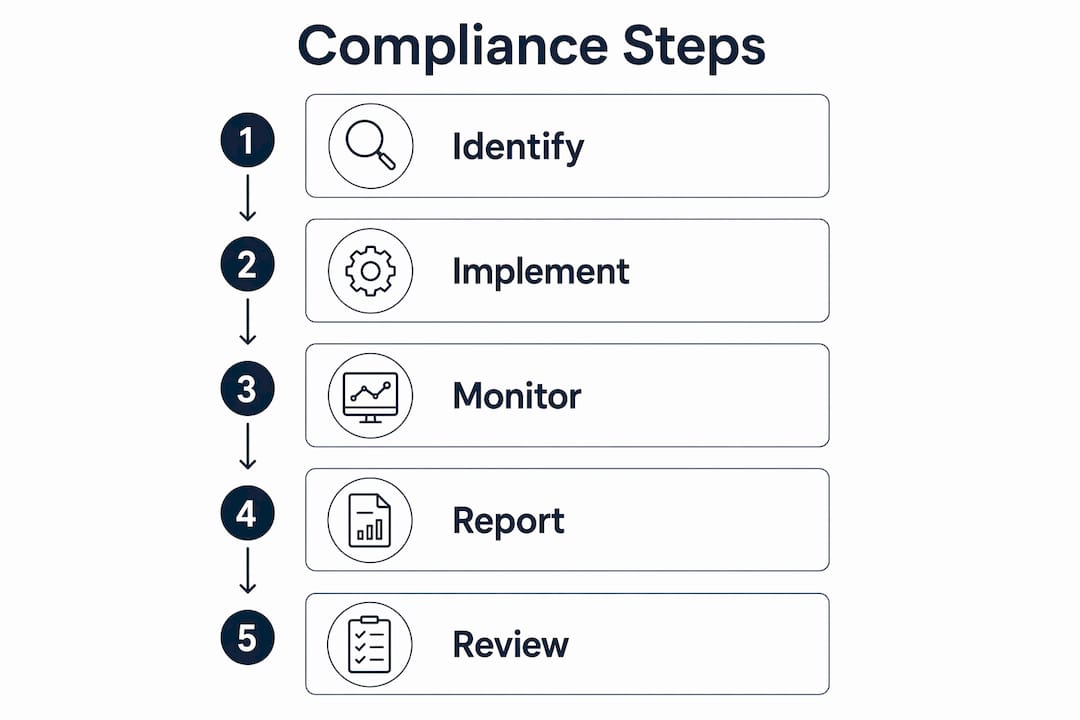
How does compliance relate to governance and risk management?
Compliance does not sit in isolation within a legal department. The OECD frames compliance as a fundamental objective of internal control frameworks, alongside operational effectiveness and financial reporting reliability. That framing elevates compliance from a legal obligation to a core governance function.
Effective governance requires compliance to be integrated across risk management, internal audit, and operational management. The OECD’s analysis of COSO’s internal control model confirms that internal audit supports compliance by providing independent evaluation and identifying gaps before they become enforcement issues. Organisations that treat audit and compliance as separate silos consistently underperform on both.
The practical steps for integrating compliance into governance are:
- Assign ownership at board and senior management level. Compliance responsibility must be explicit in governance documents, not assumed. The role of the compliance officer has expanded significantly; in well-governed organisations, it carries direct reporting lines to the board.
- Embed compliance into risk registers. Every material regulatory risk should appear in the organisation’s risk register with an owner, a likelihood rating, and a mitigation plan.
- Align internal audit with compliance objectives. Internal audit should test whether compliance controls are operating effectively, not merely whether policies exist on paper.
- Establish cross-functional compliance committees. Operations, finance, HR, and legal must all contribute to compliance governance. Siloing compliance within the legal function is a structural failure.
- Report compliance performance to the board regularly. Boards that receive compliance updates only when something goes wrong are not governing effectively.
For companies entering Bosnia and Herzegovina, Swiss corporate governance frameworks offer a useful comparative reference. They demonstrate how integrated governance structures can manage multi-jurisdictional compliance obligations with clear accountability at each level.
Pro Tip: Map your compliance obligations to specific risk owners in the business, not to job titles. When a person leaves, the obligation must transfer automatically. Ownership tied to a role, not a name, survives personnel changes.
What makes a compliance programme operationally effective?
A compliance programme is operationally effective when it prevents misconduct, detects it when it occurs, and responds to it consistently. The U.S. Sentencing Commission’s 2025 Guidelines set out the standard: programmes must be reasonably structured and actively managed, not merely documented. That standard has become a reference point for compliance programme design globally, including in European and emerging market contexts.
The core elements of an effective programme are:
- Written standards and procedures. Policies must be clear, accessible, and regularly updated to reflect changes in law and business operations.
- Genuine leadership commitment. Senior management must visibly support compliance. Programmes led nominally from the top but ignored in practice fail at the first enforcement test.
- Training and communication. Staff must understand what the rules require and why. Annual checkbox training does not meet this standard.
- Monitoring and auditing. Preventive controls must be supplemented by detective controls. Regular audits confirm whether controls are working as designed.
- Reporting mechanisms. Employees must have a confidential channel to report concerns. Whistleblower protections must be real, not theoretical.
- Consistent enforcement through incentives and discipline. The Sentencing Guidelines are explicit: compliance programmes must include consistent promotion and enforcement through incentives and disciplinary measures. Organisations that discipline junior staff but protect senior managers for the same conduct destroy programme credibility.
- Response procedures for detected misconduct. When a violation is identified, the organisation must have a defined process for investigation, remediation, and, where required, self-reporting to regulators.
The most common failure mode is what practitioners call “paper compliance.” Paper compliance occurs where policies exist but are not promoted or enforced consistently. Regulators and courts treat paper compliance as an aggravating factor, not a mitigating one.
Pro Tip: Test your compliance programme by asking a mid-level manager to explain the whistleblower process without looking it up. If they cannot, the programme is not operationally embedded.
Why is regulatory compliance critical for business success?
Non-compliance produces direct and measurable harm. Legal penalties, regulatory fines, and sanctions can be substantial across all major compliance areas, from data protection breaches under GDPR to anti-corruption violations under the OECD Convention. Beyond financial penalties, enforcement actions trigger reputational damage that affects customer relationships, financing access, and partner confidence.
Operational inefficiencies are also exposed through compliance processes. Compliance reviews regularly surface gaps in contract management, data handling, and financial controls that cost organisations money independent of any regulatory action. Addressing those gaps produces operational improvements that justify compliance investment on purely commercial grounds.
The competitive dimension is equally significant. Companies with strong compliance credentials differentiate themselves by building trust with customers, avoiding penalties, and enhancing market competitiveness. In sectors where data privacy and security are material concerns, demonstrated compliance is a commercial asset.
Regulatory compliance is not a cost centre. It is a risk management function that, when executed well, protects revenue, preserves relationships, and creates measurable competitive advantage.
For foreign investors entering Bosnia and Herzegovina, compliance credibility is particularly valuable. Local regulators, banking partners, and commercial counterparties assess compliance posture as part of due diligence. A company that can demonstrate a functioning compliance programme gains access to transactions and relationships that non-compliant competitors cannot.
Key takeaways
Regulatory compliance is an ongoing organisational commitment requiring integrated governance, active enforcement, and consistent leadership support across all business functions.
| Point | Details |
|---|---|
| Compliance is continuous | Regulatory compliance is an ongoing process, not a one-time exercise or annual checklist. |
| Governance integration is required | Compliance must be embedded across risk management, internal audit, and board-level reporting. |
| Effective programmes prevent and detect | Operational effectiveness requires preventive controls, detective audits, and defined response procedures. |
| Paper compliance is a liability | Policies without enforcement are treated as aggravating factors by regulators and courts. |
| Compliance creates competitive advantage | Strong compliance credentials build stakeholder trust and open access to regulated markets and financing. |
Compliance as a governance discipline, not a legal formality
From my experience advising companies entering complex multi-jurisdictional markets, the most persistent mistake I observe is treating compliance as the legal team’s problem. It is not. Legal counsel can identify obligations and draft policies. Only operational management can make those policies real.
The organisations that manage compliance well share one characteristic: their senior leaders understand that compliance failure is a governance failure. They do not wait for a breach to ask whether their programme is working. They build compliance performance into management reporting, tie it to accountability structures, and treat it with the same rigour they apply to financial controls.
For companies entering Bosnia and Herzegovina specifically, the multi-layered regulatory structure creates genuine complexity. Entity-level laws, state-level obligations, and progressive EU alignment requirements all apply simultaneously. The compliance checklist for Bosnia and Herzegovina is a useful starting point, but it is not a substitute for legal advice tailored to a company’s specific sector and structure. The companies that succeed here are those that invest in understanding the regulatory environment before they encounter it in an enforcement context.
— Franjo
Legal advisory support for compliance in Bosnia and Herzegovina
Foreign companies entering Bosnia and Herzegovina face a regulatory environment that requires precise mapping of obligations across multiple legal layers.

Vucic provides corporate and compliance legal services to growth-oriented companies and international investors operating in Bosnia and Herzegovina and the broader European market. The firm’s advisory work covers corporate structuring, data protection, anti-corruption compliance, and cross-border governance. For companies that need to understand what corporate law requires in this jurisdiction before committing capital, Vucic offers the practical legal guidance that turns regulatory complexity into manageable, documented risk.
FAQ
What is the definition of regulatory compliance?
Regulatory compliance is an organisation’s adherence to all applicable laws, regulations, guidelines, and standards relevant to its business operations and industry. It is an ongoing process, not a one-time exercise.
What are common regulatory compliance examples for businesses?
Common examples include GDPR for data protection, PCI DSS for payment card security, HIPAA for healthcare data, ISO 37301 for compliance management systems, and anti-corruption obligations under the OECD Anti-Bribery Convention.
Why is regulatory compliance critical for foreign investors in Bosnia and Herzegovina?
Bosnia and Herzegovina operates under entity-level and state-level laws simultaneously, creating layered obligations across data protection, labour, financial reporting, and trade compliance. Non-compliance exposes investors to penalties and reputational risk in a market where regulatory credibility directly affects financing and commercial relationships.
How do you achieve regulatory compliance in practice?
Achieving compliance requires written policies, active training, monitoring controls, confidential reporting channels, and consistent enforcement through incentives and discipline. The U.S. Sentencing Commission’s 2025 Guidelines provide a widely referenced framework for programme design.
What is the difference between compliance and corporate governance?
Corporate governance defines how an organisation is directed and controlled. Regulatory compliance is one of its core objectives, alongside operational effectiveness and financial reporting reliability. The OECD’s internal control framework treats compliance as integral to governance, not separate from it.