Why legal support for technology companies matters

TL;DR:Legal support for technology companies involves continuous legal guidance on contracts, intellectual property, employment law, and governance to mitigate risks during critical growth phases. Ongoing counsel provides strategy, stability, and regulatory compliance, especially in Bosnia and Herzegovina’s complex legal environment, fostering investor confidence and operational efficiency. Early engagement with specialized legal advisors ensures structural readiness, reducing costs and accelerating fundraising, product launches, and international expansion.
Legal support for technology companies is defined as the ongoing provision of specialist legal counsel covering intellectual property, contracts, regulatory compliance, employment law, and corporate governance. Technology firms operating in Bosnia and Herzegovina face a particularly demanding regulatory environment, where local corporate law intersects with EU-aligned data protection requirements and cross-border commercial obligations. Without dedicated legal guidance, tech entrepreneurs expose their businesses to contract liability, IP loss, and investor-readiness failures that compound as the company scales. The legal risks in technology are not theoretical. They materialise at the precise moments when a company can least afford disruption: during fundraising, product launch, or international market entry.
Why legal support for technology companies is a strategic necessity
Technology firms face a category of legal complexity that general commercial law does not adequately address. Integrated, ongoing counsel is required rather than fragmented expertise, because the legal issues in tech are interdependent. A poorly drafted software licence agreement, for example, can simultaneously create revenue recognition problems, expose proprietary code, and breach a client’s data processing obligations under GDPR.
The core legal functions that a technology company requires on a continuous basis include:
- Contract review and negotiation. Every SaaS agreement, vendor contract, and partnership arrangement carries liability exposure. Outside general counsel reviews contracts, identifies unfavourable indemnity clauses, and aligns terms with the company’s revenue model.
- Intellectual property management. Patent filings, trademark registrations, copyright assignments from developers, and trade secret protections all require active management. IP rights not formally assigned to the company remain with individual contributors, which creates serious valuation risk during due diligence.
- Employment law compliance. Tech firms frequently misclassify contractors as employees or vice versa, triggering tax liability and labour law penalties. Employment agreements, non-disclosure obligations, and HR policies must reflect current statutory requirements.
- Corporate governance. Board resolutions, shareholder agreements, and equity plan documentation must be maintained accurately to satisfy investor requirements and regulatory audits.
Pro Tip: Assign IP rights formally at the point of engagement with every developer, designer, or technical consultant. Retroactive assignment is possible but costly, and investors will flag the gap during due diligence.
The importance of legal support for tech firms becomes most visible when these functions are absent. A startup that reaches Series A without clean IP assignments, compliant employment contracts, and auditable board minutes will face a diligence process that delays or derails the round entirely.

Ad-hoc counsel versus ongoing legal support: which model works?
The distinction between ad-hoc and ongoing legal support is not merely one of frequency. It is a structural difference that affects the quality and consistency of legal judgement available to the business.
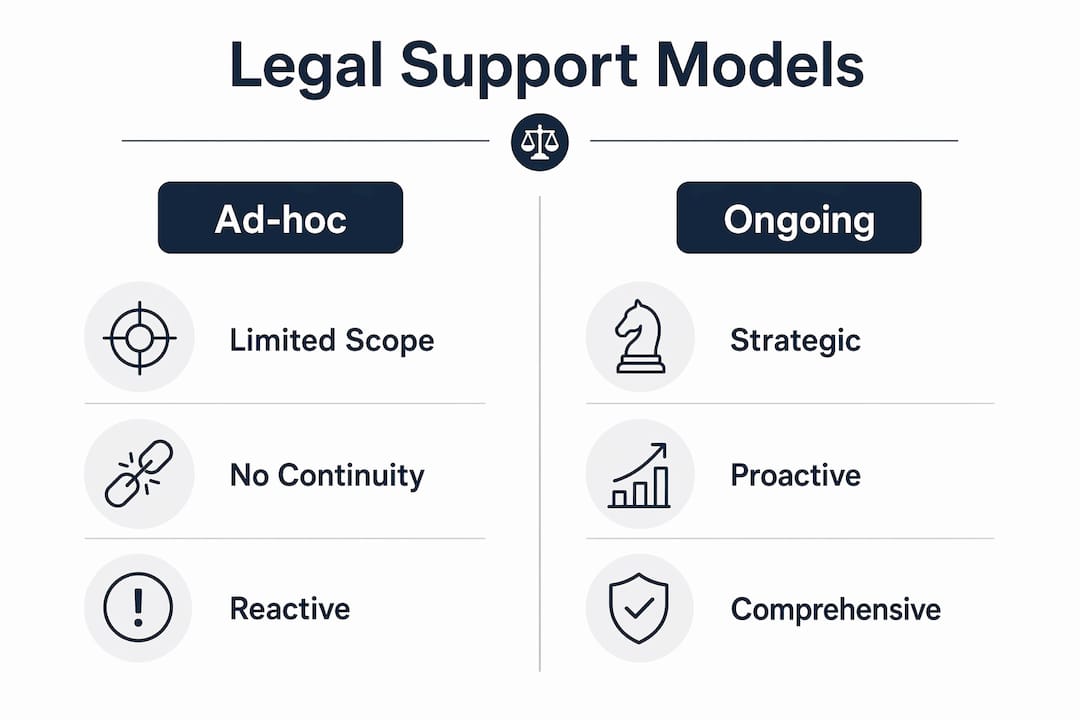
| Factor | Ad-hoc counsel | Ongoing legal support |
|---|---|---|
| Business context | Limited. Each engagement starts from scratch. | Deep familiarity with cap table, contracts, and compliance history. |
| Response time | Variable. Dependent on availability at the time of need. | Predictable. Counsel is integrated into business workflows. |
| Cost structure | Unpredictable. High hourly rates for urgent matters. | Defined retainer or fractional model. Budgetable. |
| Risk management | Reactive. Legal issues addressed after they arise. | Proactive. Risks identified before they become disputes. |
| Fundraising readiness | Inconsistent documentation and governance records. | Clean corporate records maintained continuously. |
Fractional general counsel offers startups strategic legal guidance without the overhead of a full-time hire, providing the continuity that ad-hoc counsel structurally cannot. Kruze Consulting identifies this continuity as the critical differentiator: a fractional GC understands the company’s cap table, business model, and compliance history, which means advice is calibrated to the actual business rather than a generic legal position.
Startups that rely on sporadic legal help for contracts, equity grants, and HR policies miss the benefit of strategic advice and accumulate inconsistencies that become expensive to correct. A single mishandled equity grant, for instance, can create tax complications for founders and investors that require specialist restructuring to resolve.
Pro Tip: When engaging fractional counsel, define the scope to include a quarterly legal audit covering contracts, IP assignments, employment records, and governance documentation. This prevents accumulation of legal risk between major transactions.
The benefits of legal counsel in technology extend beyond risk avoidance. Startups that replace improvisation with consistent legal judgement gain a competitive advantage by moving faster on commercial decisions, because the legal framework supporting those decisions is already in place.
How legal support complements financial and operational growth
Legal counsel does not operate in isolation from the financial and operational functions of a technology company. The most effective legal support is integrated with accounting, finance, and compliance teams to produce a coherent picture of the business that satisfies investors, regulators, and commercial counterparties.
The practical coordination points between legal and financial functions include:
- Due diligence preparation. Legal counsel maintains minute books, equity plans, and material contracts, while accounting teams prepare GAAP-compliant or IFRS-compliant financial statements. When these records are aligned, due diligence for financing and M&A proceeds without the delays that disorganised documentation creates.
- Term sheet and fundraising support. Reviewing investor term sheets requires legal counsel who understands both the commercial implications of liquidation preferences and anti-dilution provisions, and the governance obligations that accompany institutional investment.
- Board and shareholder documentation. Board resolutions authorising equity issuances, material contracts, and strategic decisions must be formally documented. Gaps in board minutes create regulatory and fiduciary risk that investors treat as a red flag.
- International compliance. Technology companies expanding into Bosnia and Herzegovina, or using it as a base for European market entry, must navigate the country’s Law on Companies, data protection obligations aligned with GDPR, and sector-specific regulatory requirements. Local legal expertise is required to manage corporate structuring, employment law, and compliance challenges specific to this jurisdiction.
Strong legal support builds investor confidence by maintaining clean corporate governance and ensuring that contracts align with the company’s stated business strategy. Investors conducting due diligence on a technology company assess legal readiness as a proxy for operational maturity. A company with well-maintained legal records signals that its management team understands the obligations that accompany growth.
Practical steps to secure effective legal support in Bosnia and Herzegovina
Technology entrepreneurs operating in or entering Bosnia and Herzegovina should approach the selection and integration of legal support as a structured process rather than an ad-hoc procurement decision. The following steps reflect the requirements of the local regulatory environment and the growth objectives typical of tech firms at various stages.
- Identify counsel with demonstrated technology sector experience. General commercial law firms may lack the specific expertise required for software licensing, data protection compliance, or equity structuring. Evaluate prospective advisors on the basis of their experience with technology clients, not merely their general corporate law credentials.
- Prioritise startup-specialised legal providers. Startups with early legal support align IP, contracts, and HR policies to growth strategies more effectively and avoid legal bottlenecks that slow fundraising and product development. Providers who understand the startup lifecycle structure their advice accordingly.
- Define the scope of engagement clearly. Establish which legal functions will be covered on a retainer basis and which will be handled as discrete matters. A well-defined scope prevents gaps in coverage and allows the company to budget legal costs accurately.
- Integrate legal counsel into key business processes. Legal advisors should be involved in commercial negotiations, product launches with regulatory implications, and hiring decisions involving senior roles or equity compensation. Reactive engagement after decisions are made reduces the value of legal support significantly.
- Leverage legal support for international market entry. Bosnia and Herzegovina’s position as an emerging technology hub with access to EU markets creates specific compliance obligations for companies with cross-border operations. Cross-border legal guidance is required to manage entity structuring, transfer pricing, and regulatory approvals across multiple jurisdictions.
The why tech companies need legal guidance question is answered most clearly at the point of international expansion. Regulatory requirements that are manageable in a single jurisdiction multiply in complexity when a company operates across borders, and the cost of non-compliance scales accordingly.
Key takeaways
Ongoing legal support is the single most effective measure a technology company can take to protect its intellectual property, maintain investor confidence, and manage regulatory compliance as it scales.
| Point | Details |
|---|---|
| IP protection is non-negotiable | Assign intellectual property rights formally at every engagement to prevent valuation risk during due diligence. |
| Ongoing counsel outperforms ad-hoc | Fractional general counsel provides continuity, business context, and proactive risk management that one-off legal help cannot replicate. |
| Legal and financial functions must align | Coordinated legal and accounting records accelerate due diligence and reduce delays in fundraising and M&A processes. |
| Local expertise is required in Bosnia and Herzegovina | Corporate structuring, employment law, and data protection compliance require counsel familiar with the specific regulatory environment. |
| Early engagement reduces cost | Startups that secure legal support before problems arise avoid the significantly higher cost of corrective legal work. |
What I have observed working with technology companies in Bosnia and Herzegovina
The most consistent pattern I see among technology companies that encounter serious legal problems is not ignorance of the law. It is the deliberate deferral of legal structuring until a transaction forces the issue. Founders understand, in principle, that IP assignments matter and that employment contracts carry risk. They defer action because legal work feels like overhead rather than investment.
The companies that scale without major legal disruption treat their legal advisor as a member of the operational team, not a service provider called in for specific transactions. They share commercial plans early, involve counsel in hiring decisions, and review contracts before signing rather than after disputes arise. This approach does not require a large legal budget. It requires a consistent relationship with an advisor who understands the business.
Bosnia and Herzegovina’s technology sector is developing rapidly, and the regulatory environment is evolving to match. Data protection obligations, employment law for remote and hybrid workforces, and the requirements of EU market access are all becoming more demanding. The companies that build legal readiness into their operating model now will be better positioned to meet those requirements as they tighten.
Legal readiness influences investor perceptions and product rollout timelines in ways that founders frequently underestimate. A clean legal structure is not merely a compliance requirement. It is a commercial asset.
— Franjo
Legal advisory services for technology companies at Vucic
Vucic provides strategic legal services designed specifically for technology companies operating in Bosnia and Herzegovina and entering European markets. The firm’s advisory covers contract law, intellectual property, data protection compliance, corporate governance, and cross-border regulatory requirements. For technology entrepreneurs who require the continuity and business context that strategic legal advice provides, Vucic offers fractional general counsel arrangements and transaction-specific support calibrated to the company’s growth stage. Engagements are structured to deliver practical legal guidance aligned with commercial objectives, without the overhead of full-time in-house counsel.
FAQ
What does legal support for technology companies include?
Legal support for technology companies covers contract review, intellectual property management, employment law compliance, corporate governance, regulatory compliance, and fundraising support. Outside general counsel performs these functions on an ongoing basis, providing strategic advice aligned with the company’s business model.
Why do tech startups need ongoing rather than ad-hoc legal counsel?
Ongoing legal counsel maintains familiarity with the company’s cap table, contracts, and compliance history, which ad-hoc counsel lacks. Startups that rely on sporadic legal help accumulate inconsistencies in governance and IP records that create costly problems during fundraising and due diligence.
What are the main legal risks for technology companies in Bosnia and Herzegovina?
The primary legal risks include inadequate IP assignment, non-compliant employment contracts, gaps in corporate governance documentation, and failure to meet data protection obligations aligned with GDPR. Local regulatory expertise is required to manage these risks within Bosnia and Herzegovina’s specific legal framework.
When should a technology company engage legal counsel?
Legal counsel should be engaged at the point of incorporation, before the first commercial contract is signed, and before any equity is issued to founders, employees, or investors. Early engagement prevents the accumulation of structural legal problems that become significantly more expensive to correct at later growth stages.
How does legal support affect investor readiness?
Clean corporate governance, properly assigned IP, and compliant employment records are standard investor requirements during due diligence. Legal readiness influences investor perceptions directly, and companies with well-maintained legal records move through fundraising processes faster and with fewer conditions attached to investment.